
ISO 14001:2026 Is Published: Changes, Deadlines and Your Transition Plan
ISO 14001:2026 was published on 15 April 2026. This guide explains the confirmed changes, the three-year timetable and what certified organisations should do now.
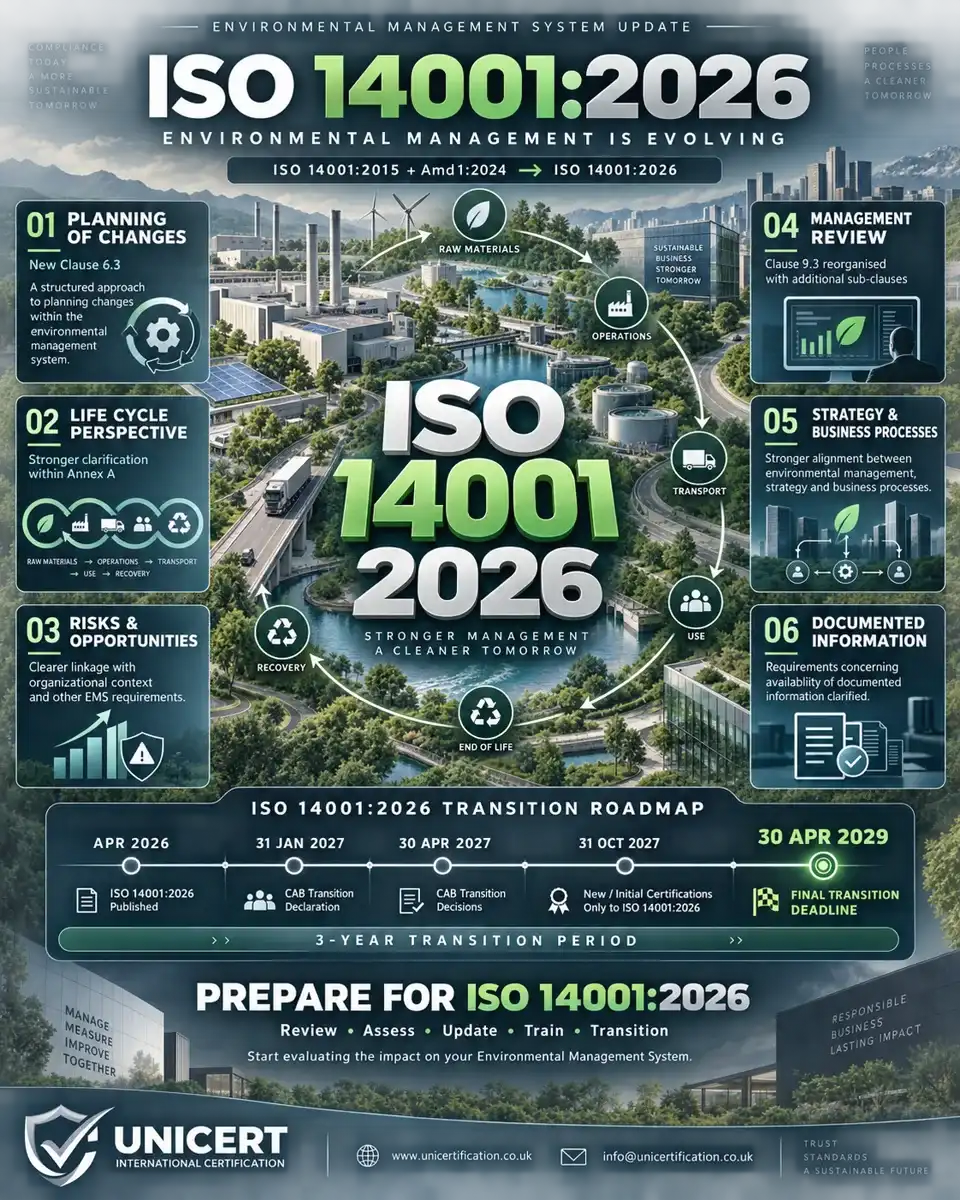
ISO 14001:2026, Environmental management systems — Requirements with guidance for use, was published on 15 April 2026. It replaces ISO 14001:2015, including Amendment 1:2024, and begins the transition to the revised environmental management system requirements.
This guide combines ISO's publication information with the supplied Global ACI-TECH-3-TR 2029-04-30 (M), Version 1.0. That document is mandatory for Global ACI MRA accreditation-body signatories and their accredited certification bodies. Your certification body's written transition arrangement remains the controlling instruction for your certificate.
The short answer for certified organisations
Your ISO 14001:2015 certificate does not become invalid immediately. Under the supplied timetable, existing certified organisations have until 30 April 2029 to complete a transition audit, receive a successful certification decision and obtain an ISO 14001:2026 certificate.
The transition audit may be combined with a scheduled surveillance or recertification audit, or completed as a separate special audit. The transition document describes the overall changes as minimal and generally achievable with reasonable effort, while recognising that the effect will depend on each organisation's context, environmental aspects and management-system maturity.
Confirmed changes in ISO 14001:2026
Planning of changes — new Clause 6.3
The revised edition adds a structured requirement for planning changes to the environmental management system. Organisations should define the purpose and likely consequences of a change, protect the integrity of the EMS, confirm resources and responsibilities, communicate the change and evaluate whether it achieved the intended result.
Stronger life-cycle perspective
Annex A gives clearer guidance on applying a life-cycle perspective. This does not require a formal life-cycle assessment in every case. It does require organisations to consider the environmental stages they can control or influence, including raw materials, design, procurement, transport, use and end-of-life treatment where relevant.
Risks, opportunities and organisational context
The revised guidance makes the connection between organisational context, environmental conditions, compliance obligations, risks and opportunities, and operational controls easier to follow. Your registers should show that these subjects inform objectives, controls and monitoring rather than operating as separate paperwork exercises.
Management review structure
Clause 9.3 is reorganised with additional subclauses. Management-review agendas and minutes should clearly cover relevant changes, environmental performance, fulfilment of compliance obligations, progress against objectives, adequacy of resources and decisions needed to improve the EMS.
Strategy, business processes and integration
The standard gives clearer guidance on aligning environmental management with strategic direction and normal business processes. Environmental controls should be part of purchasing, operational planning, investment decisions, product or service design and performance review—not a parallel system owned only by the environmental manager.
Documented information
The wording is clarified to state that required documented information shall be available. Check that current versions of procedures, criteria, evidence and records are controlled and accessible to the people who need them, including at operational locations.
ISO 14001:2026 transition dates
| Milestone | Confirmed date | What it means |
|---|---|---|
| ISO 14001:2026 published | 15 April 2026 | The revised international standard is current. |
| Accreditation bodies ready to assess | 31 October 2026 | Applicable accreditation bodies establish and announce transition arrangements. |
| Certification-body declaration due | 31 January 2027 | Applicable certification bodies submit declarations and supporting evidence. |
| Certification-body decisions complete | 30 April 2027 | Accreditation transition decisions should be completed under the supplied timetable. |
| New certifications only to ISO 14001:2026 | After 31 October 2027 | No new ISO 14001:2015 certifications may be issued under this timetable. |
| Existing-client transition complete | 30 April 2029 | Transition audit, decision and revised certificate must be completed. |
Accredited ISO 14001:2026 certification can begin only after the relevant certification body's accreditation transition is complete. Availability may therefore differ between certification bodies.
What the transition audit will examine
The supplied document requires the transition audit to review at least:
- the changed requirements of ISO 14001:2026;
- changes to the organisation's context; and
- any other changes needed in the environmental management system.
The auditor will expect objective evidence that changes are implemented and effective. That can include an approved gap analysis, revised aspect and risk evaluations, updated operational controls, competence records, internal-audit results and management-review decisions.
Additional audit time is not automatically required by the supplied transition document. Your certification body may nevertheless determine justified additional time based on the scale of your changes, audit planning and applicable audit-duration rules.
UniCert client transition plan
Phase 1 — Appoint an owner and confirm your audit window (now to October 2026)
- Appoint a transition owner and senior-management sponsor.
- Obtain a controlled copy of ISO 14001:2026.
- Confirm your surveillance, recertification and certificate-expiry dates with UniCert.
- Agree whether transition should be combined with a planned audit or scheduled separately.
Output: named responsibilities and an approved transition timetable.
Phase 2 — Complete a structured gap analysis (November 2026 to April 2027)
Compare the existing EMS clause by clause with ISO 14001:2026. Prioritise Clause 6.3, life-cycle perspective, context and risk links, management review, integration with business processes and availability of documented information.
Record each gap, its risk, action owner, target date and evidence required for closure. Do not rewrite the entire EMS where existing controls remain effective.
Output: approved gap register and action plan.
Phase 3 — Update and operate the EMS (May to October 2027)
Revise affected procedures, registers, objectives, controls and management-review arrangements. Brief relevant employees and contractors. Operate the revised controls long enough to produce meaningful records and performance evidence.
New applicants should discuss the edition and audit dates with UniCert because new ISO 14001:2015 certifications stop after 31 October 2027 under the supplied timetable.
Output: updated EMS, trained people and implementation records.
Phase 4 — Verify readiness (November 2027 to October 2028)
Conduct an internal audit against ISO 14001:2026, including operational implementation and evidence at relevant sites. Review the transition and audit results at management review. Correct nonconformities, evaluate effectiveness and retain evidence.
Output: completed internal audit, management-review decisions and closed corrective actions.
Phase 5 — Complete transition early (late 2028 to early 2029)
Complete the transition audit with a surveillance or recertification audit where practical. Do not leave the audit until April 2029: time may be needed to close findings and complete the independent certification decision before the deadline.
Output: successful transition audit and ISO 14001:2026 certification decision before 30 April 2029.
What happens if you do not transition?
Under the supplied arrangement, accredited ISO 14001:2015 certificates are no longer valid after 30 April 2029. An existing certificate cannot remain valid beyond that date merely because its printed expiry date is later.
How UniCert will support clients
UniCert will communicate the applicable transition arrangement, help clients select an appropriate audit window and explain the evidence expected for the revised requirements. Certification depends on a successful audit and independent certification decision; it is never automatic or guaranteed.
Discuss your ISO 14001:2026 transition with UniCert →
Sources and scope note
- ISO announcement: ISO 14001:2026 published
- Global ACI-TECH-3-TR 2029-04-30 (M), Transition Requirements for ISO 14001:2026, Version 1.0, supplied document; issue date 4 September 2026 and implementation date 14 September 2026.
This article is a customer-focused summary, not a substitute for the standard or the formal transition instructions applicable to your certificate.
Frequently Asked Questions
When was ISO 14001:2026 published?
ISO 14001:2026 was published on 15 April 2026 and replaces ISO 14001:2015, including Amendment 1:2024.
What is the ISO 14001:2026 transition deadline?
Under the supplied Global ACI transition requirements, existing certified organisations must complete the transition audit, certification decision and revised certificate by 30 April 2029.
What are the main ISO 14001:2026 changes?
The confirmed changes include alignment with the Harmonized Structure, a new Clause 6.3 on planning changes, clearer life-cycle perspective guidance, stronger links between context and risks, reorganised management review, closer alignment with strategy and business processes, and clarified documented-information requirements.
Can the transition audit be combined with surveillance?
Yes. The supplied requirements permit the ISO 14001:2026 transition audit to be combined with surveillance or recertification, or completed through a separate special audit.
When do new certifications have to use ISO 14001:2026?
Under the supplied timetable, all new or initial certification must be to ISO 14001:2026 after 31 October 2027. Applicants should confirm the applicable edition and schedule with their certification body.
Related certifications:

Take the Next Step with UniCert
From ISO 9001 quality management to cyber security and supply chain assurance – UniCert provides the management system certification you need to unlock global markets.