
ISO 9001:2026 Is Published: Changes, Deadlines and Your Transition Plan
ISO 9001:2026 was published on 16 September 2026. This confirmed guide explains the changes, the three-year timeline and what certified organisations should do next.
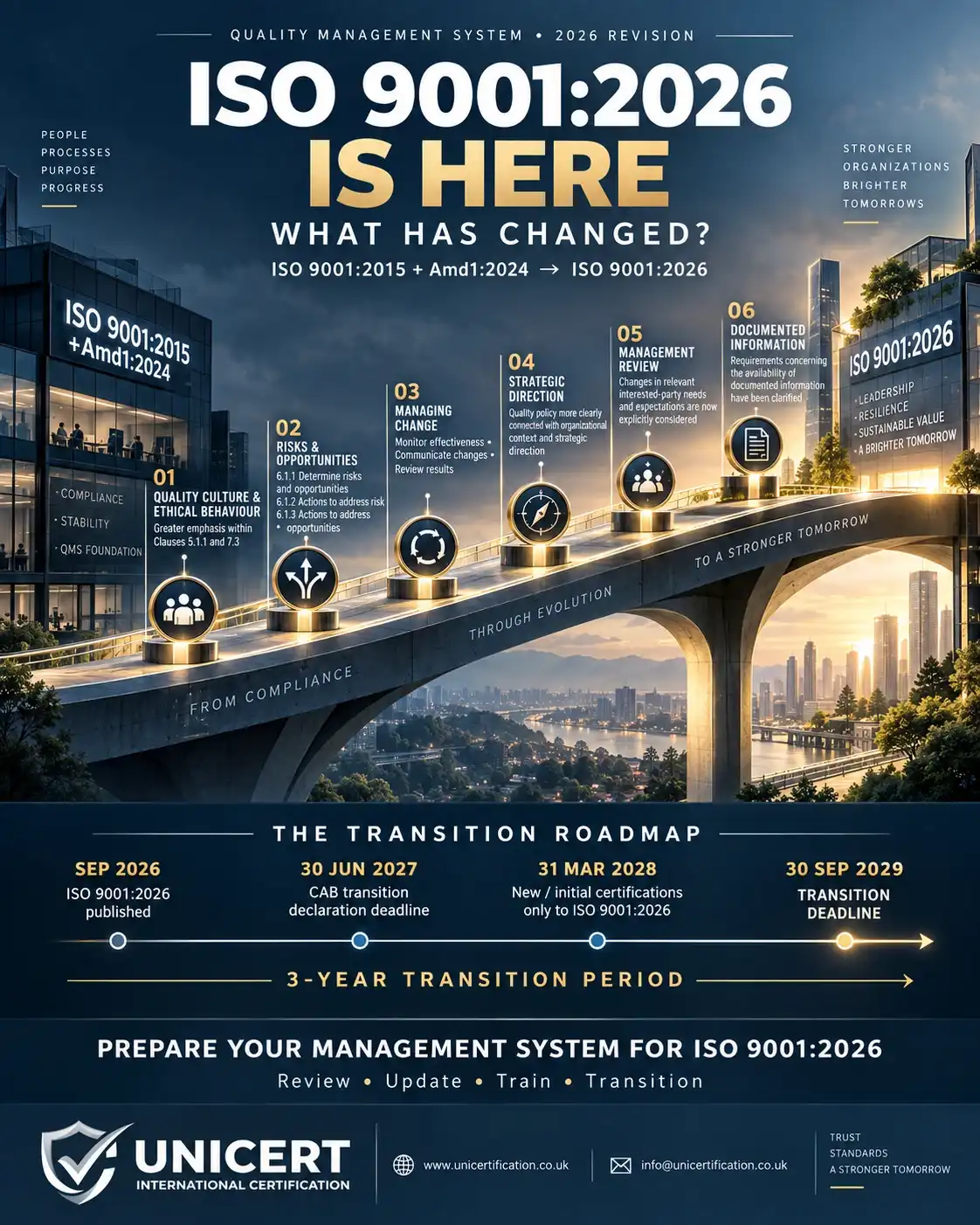
ISO published ISO 9001:2026, Quality management systems — Requirements, on 16 September 2026. It is the sixth edition of the world’s most widely used quality management system standard and replaces ISO 9001:2015, including Amendment 1:2024.
This article combines the confirmed publication information with the transition requirements in Global ACI-TECH-3-TR 2029-09-30 (M), Version 1.0. That transition document is mandatory for Global ACI MRA accreditation-body signatories and their accredited certification bodies. Your certification body’s communicated arrangements remain the controlling instructions for your certificate.
The short answer for certified organisations
Your ISO 9001:2015 certificate does not become invalid immediately. The transition period is three years, ending on 30 September 2029. A transition audit must be completed and the revised certificate issued before that date. The audit may be combined with a planned surveillance or recertification audit, or conducted as a separate special audit.
The transition document describes the changes as limited overall and generally achievable with reasonable effort. The real impact depends on your organisation’s context, processes and the maturity of its quality management system.
Confirmed key changes in ISO 9001:2026
Harmonized Structure and terminology
The edition aligns with the Harmonized Structure and TMB Resolution 16/2025. Terms and definitions have been updated, with quality-specific definitions added for the quality management system, quality policy and quality objectives. ISO 9000 remains the normative reference for quality terminology.
Documented information
The wording around documented information has been clarified, including the requirement that necessary documented information shall be available. Organisations should therefore check not only whether documents exist, but whether current, controlled information is available where and when people need it.
Quality culture and ethical behaviour
Clause 5.1.1 has been reorganised and now explicitly addresses leadership’s role in promoting quality culture and ethical behaviour. Clause 7.3 also brings these themes into awareness. Evidence should go beyond a policy statement: leadership decisions, communication, objectives, conduct and everyday practices should reinforce the stated culture.
Risks and opportunities are separated more clearly
Clause 6.1 is reorganised into:
- 6.1.1 — Determining risks and opportunities
- 6.1.2 — Actions to address risks
- 6.1.3 — Actions to address opportunities
This clearer separation means organisations should be able to show how they identify both threats and beneficial opportunities, decide what action is proportionate and evaluate whether those actions worked.
Managing change becomes more explicit
Clause 6.3 adds clearer expectations for effective implementation. Planning should address how the effectiveness of change will be monitored and evaluated, how the change will be communicated and how its results will be reviewed.
Management review inputs are refined
Clause 9.3.2 now includes changes in the relevant needs and expectations of interested parties and reorganises other inputs. Management review agendas and minutes should be checked so that these inputs and resulting decisions are visible.
Annex guidance is revised
Informative Annex A has been modified to clarify the requirements of ISO 9001:2026, while Annex B has been removed. Annex A supports interpretation but does not create extra certification requirements.
Confirmed ISO 9001:2026 transition dates
| Milestone | Confirmed date | What it means |
|---|---|---|
| ISO 9001:2026 published | 16 September 2026 | The revised international standard is now current. |
| Accreditation bodies ready to assess | No later than 31 March 2027 | Accreditation bodies establish and communicate their transition arrangements. |
| Certification-body declaration due | 30 June 2027 | Applicable certification bodies submit their declaration and supporting evidence to their accreditation body. |
| Certification-body transition decisions complete | 30 September 2027 | Accreditation decisions should be completed under the stated Global ACI timetable. |
| New/initial certifications only to ISO 9001:2026 | 31 March 2028 | Under this timetable, no new ISO 9001:2015 certifications may be issued after this date. |
| Existing-client transition complete | 30 September 2029 | Transition audit, certification decision and revised certificate must be completed. |
Accredited ISO 9001:2026 certification can begin only after the relevant certification body’s accreditation has transitioned. Exact availability can therefore differ between certification bodies and accreditation arrangements.
What the transition audit will cover
The transition audit must review at least:
- the changed requirements of ISO 9001:2026;
- changes to the organisation’s context; and
- any other changes needed in the organisation’s quality management system.
It may be carried out with your surveillance audit, with recertification, or as a special audit. Remote delivery using information and communication technology may be possible where the audit objectives can demonstrably be achieved.
Additional audit time is possible, not automatic. The certification body must consider the scale of changes to your management system and whether transition is combined with a normal audit. Any additional time should be justified under the applicable audit-duration rules.
UniCert client transition plan
Phase 1 — Understand and assign responsibility (now to December 2026)
- Name a transition owner and management sponsor.
- Obtain a controlled copy of ISO 9001:2026 and brief the management team.
- Contact UniCert to confirm your current audit cycle, certificate expiry and likely transition-audit window.
- Avoid rewriting the whole QMS before completing a structured comparison.
Output: named owner, agreed governance and an initial transition timetable.
Phase 2 — Complete a clause-by-clause gap analysis (January to June 2027)
Compare your current system with the revised clauses. Pay particular attention to:
- evidence of quality culture and ethical behaviour;
- separate treatment of risks and opportunities;
- change planning, communication and effectiveness review;
- relevant interested-party needs in management review;
- availability and control of documented information; and
- competence and awareness implications.
Classify each gap as documentation, implementation, competence or evidence. Assign an owner, due date and acceptance evidence.
Output: approved gap register and action plan.
Phase 3 — Update and implement the system (July 2027 to March 2028)
Update only the documents and controls that need to change. Brief affected employees, implement revised processes and retain evidence that the new arrangements are operating. For planned changes, record intended results, responsibilities, communication, monitoring and post-change review.
If you are pursuing first certification, note the 31 March 2028 cut-off in the supplied timetable for new ISO 9001:2015 certifications. Discuss the correct certification edition with UniCert before fixing audit dates.
Output: revised QMS, trained personnel and implementation records.
Phase 4 — Verify readiness (April to December 2028)
Run an internal audit against ISO 9001:2026 and include the transition in management review. Check that changes are effective in practice, not only documented. Close corrective actions and assemble objective evidence for the transition audit.
Use our ISO 9001 internal audit checklist and audit preparation guide to structure this work.
Output: internal-audit results, management-review decisions and closed actions.
Phase 5 — Complete certification transition (during 2028 or early 2029)
Schedule the transition with a surveillance or recertification audit where practical. Leaving the audit until the final months creates avoidable risk if nonconformities require correction or a certification decision is delayed. A sensible target is to complete the transition well before 30 September 2029.
Output: successful transition audit and ISO 9001:2026 certification decision.
What happens if an organisation does not transition?
Accredited ISO 9001:2015 certifications under the stated transition arrangement are no longer valid after 30 September 2029. If an organisation decides not to transition, its certificate cannot remain valid beyond the transition end date, even where its original certification cycle would otherwise run later.
What should new certification applicants do?
Do not delay quality-system implementation. Begin with process control, customer requirements, objectives, risk-based thinking, internal audit and management review. However, the edition used for certification must follow the certification body’s accredited availability and the transition timetable. Ask UniCert to confirm the correct route for your planned Stage 1 and Stage 2 dates.
How UniCert will support clients
UniCert will communicate the applicable transition arrangement, help clients select a suitable audit window and explain the objective evidence expected for the changed requirements. Certification remains subject to a successful audit and independent certification decision; transition is never automatic or guaranteed.
Speak with our team about your ISO 9001:2026 transition →
Sources and scope note
- ISO announcement: ISO 9001:2026 published 16 September 2026
- Global ACI-TECH-3-TR 2029-09-30 (M), Transition Requirements for ISO 9001:2026, Version 1.0, supplied transition document, issue date 4 September 2026 and implementation date 16 September 2026.
This guide summarises the supplied transition document for customers. Where another accreditation arrangement applies, follow the dates and instructions formally communicated by your certification body.
Frequently Asked Questions
When was ISO 9001:2026 published?
ISO 9001:2026 was published on 16 September 2026 and replaces ISO 9001:2015, including Amendment 1:2024.
Do I need to transition from ISO 9001:2015 to ISO 9001:2026?
Yes. Under the supplied Global ACI transition requirements, existing certified organisations must complete their transition audit, certification decision and revised certificate by 30 September 2029. Follow the specific arrangements communicated by your certification body.
What are the main changes in ISO 9001:2026?
Confirmed changes include alignment with the Harmonized Structure, clarified documented-information wording, explicit leadership and awareness expectations for quality culture and ethical behaviour, a clearer split between risks and opportunities, stronger planning for change, revised management-review inputs and updated Annex A guidance.
Can the ISO 9001:2026 transition audit be combined with a surveillance audit?
Yes. The supplied transition requirements allow the transition audit to be conducted with a scheduled surveillance or recertification audit, or as a separate special audit. The certification body will determine whether additional justified audit time is needed.
What is the deadline for new ISO 9001:2015 certifications?
Under the supplied Global ACI timetable, new or initial certification must be to ISO 9001:2026 after 31 March 2028. Applicants should confirm the applicable edition and audit schedule with their certification body.
Related certifications:

Take the Next Step with UniCert
From ISO 9001 quality management to cyber security and supply chain assurance – UniCert provides the management system certification you need to unlock global markets.