ISO 9001 for Manufacturing: A Certification How-To
ISO 9001 for manufacturing means running your production flow, from goods-in to final release, as a set of documented, repeatable processes that you can prove are working. Certification does not pass or fail your product. It confirms that your quality management system meets the ISO 9001:2015 requirements and that your people follow it in practice [1]. Most SMEs start ISO 9001 certification in the UK because a customer or a tender asks for a certificate, then keep the system because it reduces scrap, rework and argument. Many later fold quality into a wider integrated management system certification that also covers environment and health and safety. This guide maps the requirements to the shop floor and walks through the steps to a certificate.
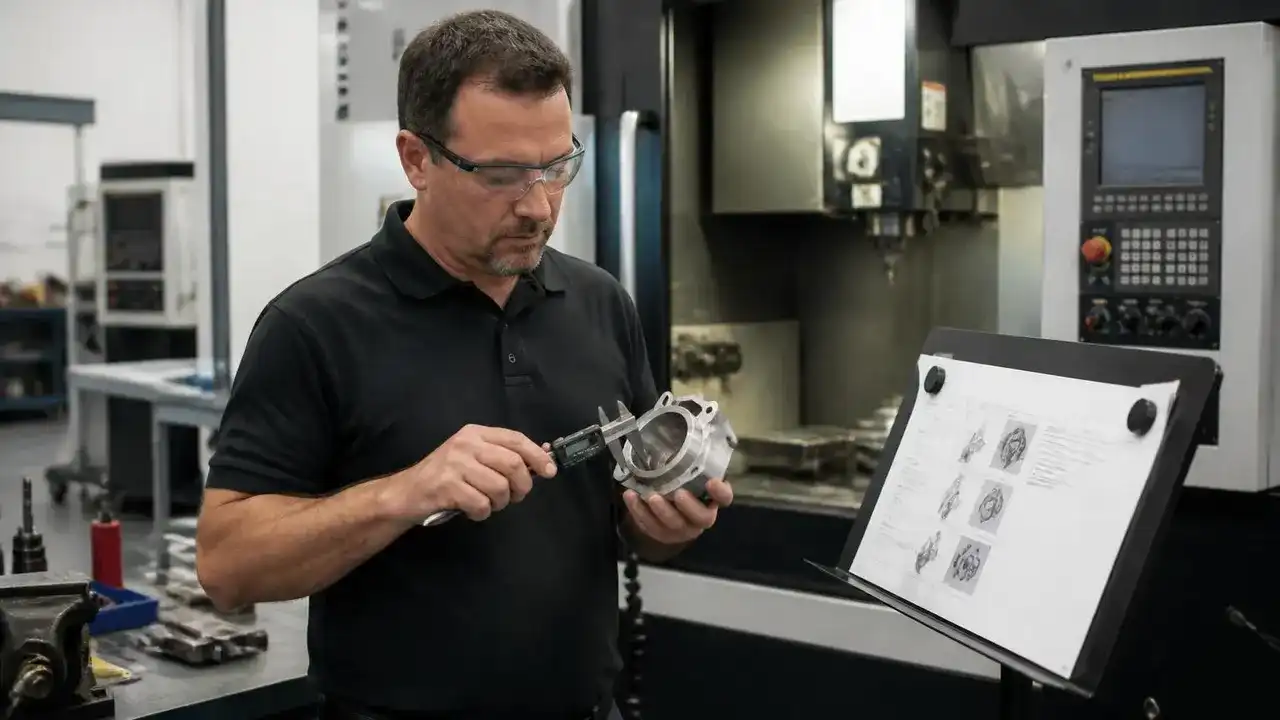
Shop-floor inspection against the current work instruction is where Stage 2 evidence is built. Source: UniCert
What ISO 9001 requires in a manufacturing context
ISO 9001:2015 has 10 clauses, and clauses 4 to 10 hold the requirements an auditor can check [1]. ISO 9001 is the world's most widely used quality management standard, with more than one million valid certificates recorded across over 180 countries in the ISO Survey [2]. The text is generic on purpose, so the work for a manufacturer is translating each clause into plant terms. Our ISO certification for manufacturers work almost always starts with that translation.
In practice, the translation lands on the same building blocks: standardised work instructions, competency-based training, process monitoring, document and change control, control of nonconforming outputs, corrective and preventive action, calibration of monitoring and measuring equipment, and management of suppliers and outsourced processes. The standard also puts real weight on understanding and meeting customer requirements. Contract and OEM manufacturers are expected to engage clients actively to pin down needs, preferences and expectations before the job runs, not after the first reject [6].
Clause 4: Context of the organisation
Decide what the QMS covers: which sites, product lines and processes are in scope, and which are not. Identify your interested parties, such as customers, regulators and owners, and what they require. Map your processes end to end and show how they connect.
Clause 5: Leadership
Top management owns the system. They set the quality policy, make roles and authorities clear, and keep customer focus visible. On the floor, this shows up as a supervisor who knows when they are allowed to stop a job.
Clause 6: Planning
Identify risks and opportunities that affect product conformity, set measurable quality objectives such as first-pass yield, scrap rate and on-time delivery, and plan changes so they do not disrupt quality.
Clause 7: Support
Provide the people, equipment and working environment the job needs. This clause holds the calibration requirement at 7.1.5 for monitoring and measuring resources, competence and training records, staff awareness, and control of documented information such as drawings, work instructions and quality records [1].
Clause 8: Operation
The largest clause and the core of a manufacturing QMS [1]. It covers operational planning (8.1), determining and reviewing customer requirements including contract and order review (8.2), design and development where you do it (8.3), control of externally provided processes, products and services, meaning suppliers and subcontractors (8.4), control of production and service provision (8.5), release of products including final inspection sign-off (8.6), and control of nonconforming outputs (8.7).
Clause 9: Performance evaluation
Monitor and measure your processes and product, collect customer feedback, run internal audits on a planned programme, and hold management reviews that act on the data rather than file it.
Clause 10: Improvement
React to nonconformities, contain them, run corrective action that removes the cause, and keep looking for improvement across the plant.
How to get certified as a manufacturer
Work through the steps below in order, the same route covered in our guide to how to get ISO 9001 certified in the UK. Most manufacturers reach initial certification three to six months after starting, and the constraint is shop-floor readiness rather than paperwork: back-filling calibration records, aligning work instructions with current drawing revisions, completing one full internal audit round across every process, and holding a management review [6]. The schedule below assumes that groundwork.
- Gap analysis. Compare current practice against clauses 4 to 10. Walk the line, read a batch record end to end, and list what is missing or undocumented. The output is a prioritised action plan with owners and dates. A structured gap analysis is the cleanest way to decide whether you are ready to book an audit.
- Build the QMS documentation. Write the quality policy, objectives, process maps and the procedures and work instructions the plant actually needs. Keep documents lean and version-controlled. Aim for instructions an operator can follow, not a manual for the auditor.
- Train the shop floor. Brief operators, setters, inspectors and supervisors on the parts of the system they use: where to find the current instruction, how to record checks, what to do with a suspect part. Keep attendance and competence records.
- Run internal audits and a management review. Audit every clause and every key process at least once before the certification body arrives. Raise your own nonconformities, fix them, and hold a documented management review of results, feedback and objectives.
- Stage 1 audit. The certification body checks that your QMS is designed, documented and ready. Expect a review of scope, policy, objectives, internal audit results and management review, plus a short site look. Findings here are usually about readiness, and you get time to close them [4].
- Stage 2 audit. The implementation audit. Auditors sample the shop floor and records to confirm the system runs as described. Close any nonconformities within the agreed period, and the certificate is issued [4].
- Surveillance and recertification. Annual surveillance audits check that the system stays live and improves. Recertification follows every three years [4].
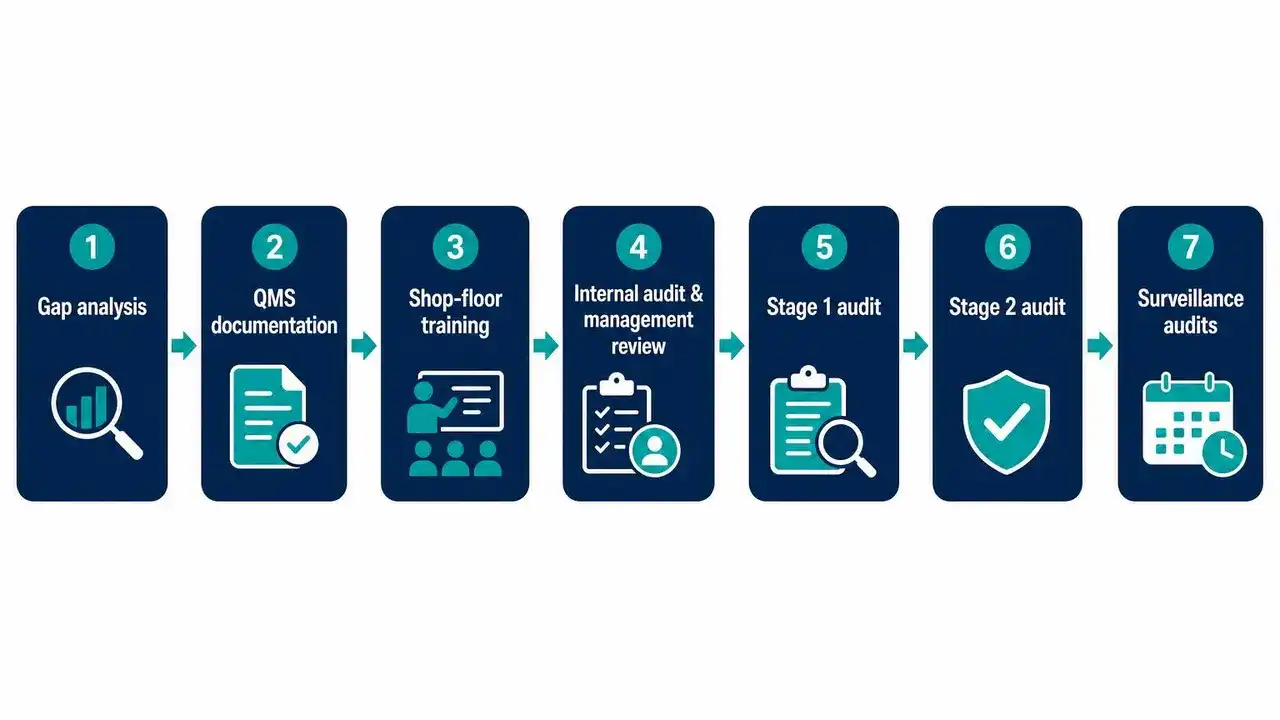
The seven-step route from gap analysis to a certificate and ongoing surveillance. Source: UniCert
Accredited certification bodies size audit duration using IAF MD 5, starting from your effective employee headcount and adjusting for risk and complexity [3]. A 40-person single-site machine shop and a 200-person multi-process plant will therefore see different audit days.
What auditors look at on the shop floor
On a manufacturing Stage 2 audit, the evidence auditors weigh most sits at the process: calibration, production control, nonconforming parts, incoming inspection, and whether operators work to current instructions. In the audits I run, most of the day is spent on the floor rather than in the meeting room. A short audit preparation checklist for UK manufacturers covers the same ground before the visit.
Calibration and traceability
Every gauge, caliper, torque wrench and test rig used to accept or reject product needs a calibration status you can trust: an identifier, a due date, and a certificate that traces back to a national standard [1]. Lapsed or non-traceable calibration records at Clause 7.1.5 and weak control of production sit among the nonconformities auditors raise most often [5], and manufacturers are especially exposed because they own so many measuring devices. Auditors also check identification and traceability of the product itself: can you take a finished part number and trace it back to a heat number, a batch, a machine and an operator.
Control of production and service provision (8.5)
Auditors confirm that production runs under controlled conditions: the right instruction at the station, defined process parameters, in-process checks at set points, suitable equipment, and control of changes so a mid-run modification is authorised and recorded [1]. Where you cannot fully verify output by later inspection, for example welding or heat treatment, they look for process validation [1]. They also check preservation and handling, and control of any property belonging to the customer, such as supplied tooling or free-issue material.
Nonconforming outputs (8.7)
Suspect and reject parts must be identified and physically separated so they cannot reach a customer by accident [1]. Auditors look for a quarantine location, clear labelling, and a disposition record that shows who decided to scrap, rework, use-as-is or return, and on what authority.
Incoming inspection
Externally provided material and processes (8.4) need controls sized to their risk [1]. Auditors check how you approve and monitor suppliers, what you inspect on receipt, and how you handle a supplier nonconformity. Certificates of conformity filed without any check against the order are a common weak point.
Work instructions and competence
Auditors compare the instruction at the station with the current drawing or specification, then ask the operator to talk through the job. The instruction must be current, usable and actually used. Competence records should show that the person running the process has been trained and assessed for it, not just inducted.
Adding health and safety on the shop floor
If machine guarding, manual handling, noise and lockout/tagout are already on your risk register, ISO 45001 is the logical next layer on the same management system. If you are moving across from the old occupational health and safety standard, the structure and duties have changed: see how ISO 45001 differs from OHSAS 18001.
Environmental aspects in manufacturing
Swarf, coolant, solvent use, waste segregation and energy are the environmental aspects auditors see most in factories. If you plan to certify ISO 14001 as well, the implementation audit is where aspects, legal compliance and operational control get tested: see passing an ISO 14001 Stage 2 audit.
Requirements also shift by sector. A precision machining shop, a food manufacturer and a firm doing site-based fabrication all read the same clauses differently, and construction work brings its own legal duties: see ISO 9001 and ISO 45001 for construction under CDM 2015. Automotive suppliers usually need IATF 16949, which is built on ISO 9001 with sector-specific requirements added.
Common pitfalls for manufacturers
Most manufacturing nonconformities trace back to a short list of recurring gaps. Watch for these.
- Treating the QMS as a document set the quality manager owns, with no buy-in from setters and supervisors.
- Calibration registers that list equipment but miss due dates, or certificates with no traceability statement.
- Work instructions written for the audit rather than the operator, and not updated when the process or drawing changes.
- No real contract or order review, so customer-specific requirements never reach the line.
- Nonconforming parts stored in the same area as good stock, with no quarantine and no disposition record.
- Internal audits that confirm paperwork exists but never walk the process or follow a batch record.
- Corrective actions that fix the one bad part and never ask why the process let it through.
FAQ
Does ISO 9001 certification mean my products are defect-free?
No. Certification confirms that you have a quality management system meeting ISO 9001:2015 and that you follow it [1]. It is an assurance that problems are controlled, contained and acted on, not a guarantee that every part conforms. Buyers who read the certificate as a zero-defect promise have misread it.
How long does ISO 9001 certification take for a manufacturer?
Around three to six months of preparation for most manufacturers, then the two-stage initial audit [6]. The variable is not the paperwork, it is how much shop-floor evidence you need to build first: calibration back-fill, current work instructions, a full internal audit round and one management review. The step-by-step route is set out in how to get ISO 9001 certified in the UK.
How much of ISO 9001 applies to the shop floor rather than the office?
Most of Clause 8 and large parts of Clause 7 are lived on the floor: production control, in-process checks, nonconforming parts, calibration, work instructions and competence [1]. Clauses 4, 5, 6, 9 and 10 are mostly management activities, though internal audit and corrective action reach right back to the line.
Do we need a UKAS-accredited certificate?
It depends on your buyers. Some UK public-sector and large private procurement rules expect a certificate from a body accredited by UKAS or an equivalent national accreditation body. Check that the certification body's accreditation scope covers ISO 9001 before you sign, because an unaccredited certificate can be rejected at tender stage.
Can we exclude product design from our ISO 9001 scope?
Yes, if you do not carry out design and development, for example a build-to-print or contract manufacturer working entirely to customer drawings. You state the exclusion of Clause 8.3 in your scope and justify it [1]. You cannot exclude a requirement simply because it is inconvenient.
Turning the clauses into shop-floor habits
ISO 9001 for manufacturing rewards the habits a good plant already values: clear instructions, calibrated equipment, controlled changes and honest handling of scrap. Close the gaps against clauses 4 to 10, prove the system runs for a few months, and the two-stage audit becomes a check rather than a scramble. Book the audit with a plan in hand, using an audit preparation checklist for UK manufacturers. If environment and safety obligations are also on your plate, plan the route to integrated management system certification now, so you build one system instead of three. Before you commit to a certification body, confirm its accreditation scope matches what your customers will accept.
Editorial note: UniCert is UAF-accredited for ISO 9001, ISO 14001 and ISO 45001, and an IAF MLA signatory through that accreditation. See the UniCert accreditation page for current scope.
References
- ISO, "ISO 9001:2015, Quality management systems, Requirements", iso.org/standard/62085.html. Clause structure (4 to 10), Clause 7.1.5 monitoring and measuring resources, Clause 8.5 control of production and service provision including validation where output cannot be verified, Clause 8.4 externally provided processes, Clause 8.7 control of nonconforming outputs, and rules on scope and exclusions.
- ISO, "The ISO Survey of certifications to management system standards", iso.org/the-iso-survey.html. Global count of valid ISO 9001 certificates and number of reporting countries.
- IAF, "IAF MD 5, Determination of Audit Time of Quality, Environmental, and Occupational Health and Safety Management Systems", iaf.nu. Audit-time calculation from effective headcount, adjusted for risk and complexity.
- ISO/IEC, "ISO/IEC 17021-1, Conformity assessment, Requirements for bodies providing audit and certification of management systems", iso.org/standard/61651.html. Two-stage initial audit, annual surveillance, and the three-year certification cycle.
- Novelvista; Glocert International; Verge Academy, commentary on frequently raised ISO 9001 findings at Clauses 7.1.5 and 8.5 (secondary).
- SimplerQMS, "QMS for Manufacturing"; 9001simplified, "ISO 9001 for Manufacturing"; p3logiq, on typical SME preparation timescales and customer-requirement engagement for contract and OEM manufacturers (secondary).
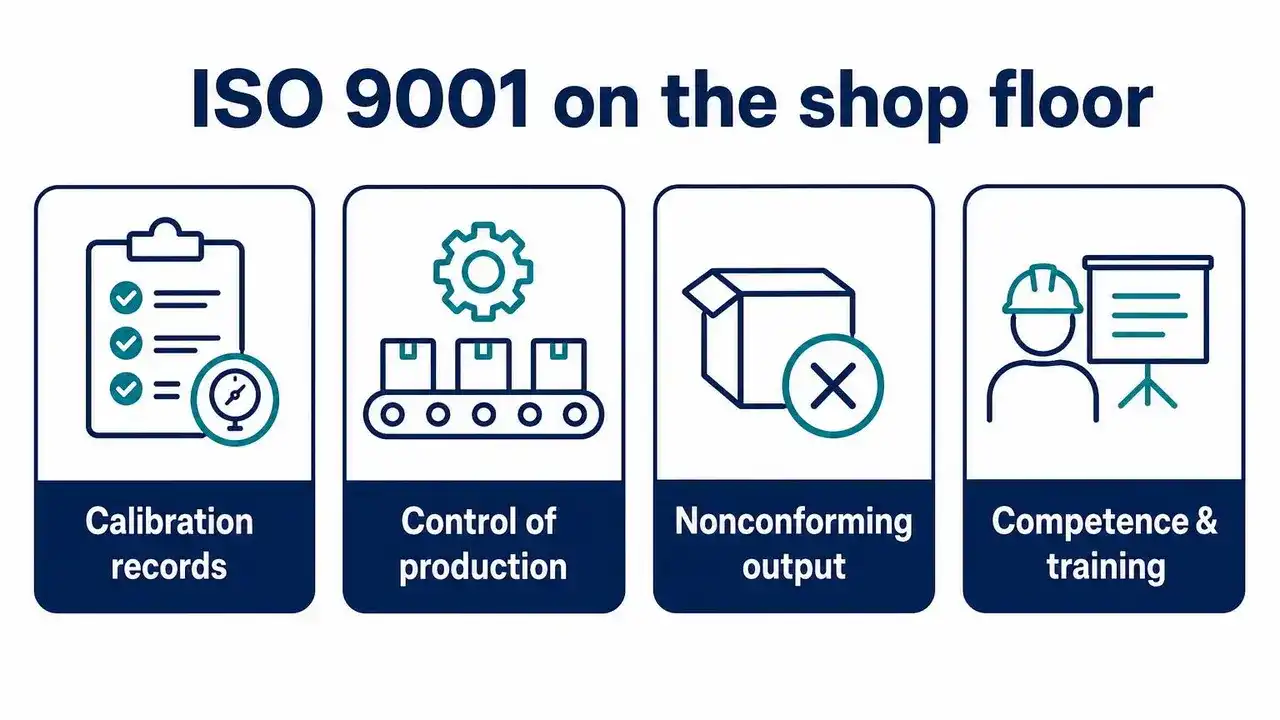
Practical summary of the key steps covered in this guide. Source: UniCert