
How to Get ISO 9001 Certified in the UK
A practical UK guide to ISO 9001 certification: process, Stage 1 and Stage 2 audits, IAF MD 5 audit-time rules, accreditation checks, cost factors and readiness gaps.
By Ersin Çetin, General Manager — UniCert Certification Ltd. · Last updated 21 July 2026 · Next review scheduled after publication of ISO 9001:2026.
Quick answer
ISO 9001 certification in the UK is issued by a certification body, not by a consultant, following a Stage 1 and Stage 2 audit and an independent certification decision. Typical projects take several months, but timelines depend on the organisation's starting point. Certification-body fees are driven mainly by the audit time determined under IAF MD 5, plus scope, effective personnel, sites, shifts, complexity and travel. For accredited certification and stronger procurement assurance, verify that the certification body is currently accredited for ISO 9001 within the relevant scope. Gap analysis is optional, not a mandatory certification stage.
Check whether your organisation is ready for certification →
Table of Contents
What is ISO 9001 certification?
ISO 9001 is the international standard for quality management systems (QMS). Certification is independent, third-party confirmation that an organisation's QMS meets the requirements of the standard within a defined scope. For the authoritative overview, see ISO 9001 on iso.org. ISO 9001 certification is issued by a certification body, not by a consultant, trainer or software vendor. For accredited certification, choose a certification body whose ISO 9001 accreditation, technical scope and current status can be independently verified.
Learn more on our ISO 9001 certification service page.
Who can get ISO 9001 certified in the UK?
Any UK organisation — from a sole trader to a multi-site enterprise, in any sector — can pursue ISO 9001 certification, provided it can define a clear certification scope and demonstrate a QMS in real operation with objective evidence. There is no minimum headcount or turnover. Audit time and cost scale with the effective number of personnel and complexity, so smaller organisations typically incur fewer audit days than larger ones.
How to get ISO 9001 certified: step-by-step
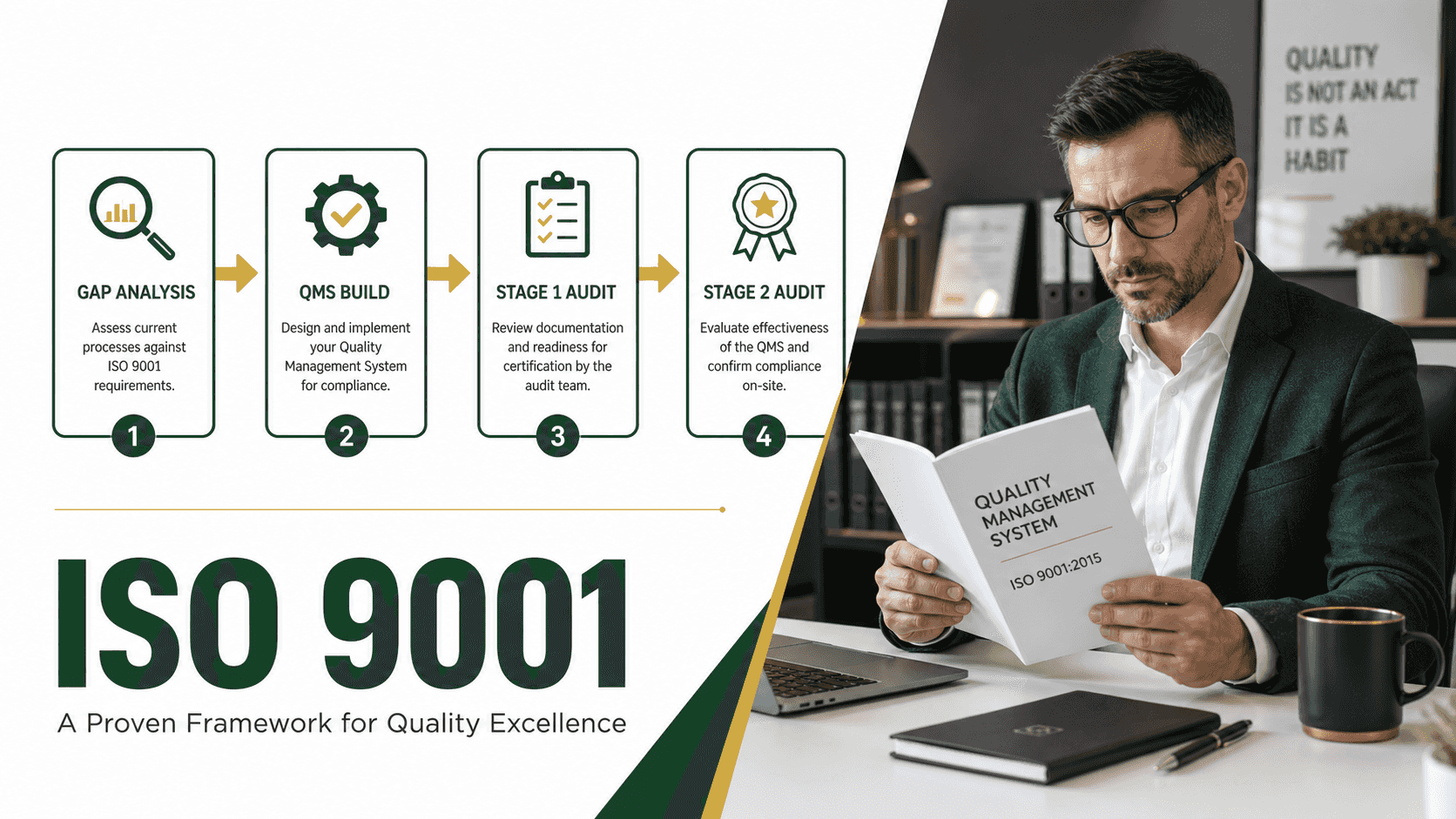
Not every step below is a formal certification stage. Steps 1 to 6 are preparation and procurement activities led by the organisation. Stages 7 and 8 are certification audits conducted by the certification body. At Step 9, the organisation implements the required correction and corrective action, while the certification body evaluates the submitted evidence. Step 10 is the certification body's final decision. Gap analysis is optional and is not a mandatory stage of ISO 9001 certification.
1. Define the certification scope
Identify the products, services, sites, functions and any permissible exclusions the QMS will cover. The scope statement will appear on the certificate.
2. Conduct an optional gap assessment
Performed internally or by an independent consultant to compare current practice against ISO 9001 requirements. Useful for planning but not required for certification.
3. Build and implement the QMS
Establish policies, processes, roles, competence, controls, and the risks and opportunities relevant to the organisation's context. Documented information should be appropriate to the organisation — ISO 9001 does not prescribe fixed templates such as a "quality manual" or "risk register".
4. Operate the system and retain evidence
The QMS must be in real, day-to-day use, generating records that show conformity over time. Certification bodies expect a reasonable period of operating evidence before Stage 2.
5. Complete internal audit and management review
Complete the internal audit programme and management review in sufficient time before the certification audit. Ensure that the required records, findings, actions and documented outputs are available for the certification body's readiness evaluation and Stage 2 audit.
6. Choose an accredited certification body
Verify the certification body's accreditation, technical scope and current status before contracting. See the accreditation checklist below.
7. Complete the Stage 1 audit
Stage 1 evaluates the proposed certification scope, key QMS processes, relevant documented information, site conditions, applicable statutory and regulatory requirements, and readiness for Stage 2. It also considers the status of internal audits and management review. Depending on the organisation and audit programme, Stage 1 may be conducted remotely, on site or through a combination of both.
Note: A "Statement of Applicability" is a requirement of ISO/IEC 27001, not ISO 9001, and is not produced for ISO 9001 certification.
8. Complete the Stage 2 audit
Stage 2 normally includes on-site evaluation across the locations covered by the certification scope. Depending on the audit programme and applicable auditing rules, approved remote techniques may supplement — but do not automatically replace — the required on-site evaluation. The audit evaluates the implementation and effectiveness of the QMS against ISO 9001 requirements through interviews, observation and sampling of records.
9. Address nonconformities
Where nonconformities are raised, the organisation is responsible for correction, root-cause analysis and corrective action. The certification body evaluates the submitted evidence and determines whether additional verification is required. Depending on the finding and the certification body's procedures, closure may be achieved through evidence review alone, or may require additional on-site verification.
10. Independent certification decision
The certification decision is made independently by the certification body's decision function after reviewing the audit file and the corrective-action evidence. The audit team does not make the final certification decision by itself. Once positive, an ISO 9001 certificate is issued for the agreed scope.
ISO 9001 certification readiness checklist
Use this checklist to sense-check readiness before applying to a certification body. Items are typical practice; documentation format may vary between organisations.
- Certification scope defined (products, services, sites, exclusions)
- Products/services and locations identified
- QMS processes and responsibilities established
- Quality policy and measurable objectives in place
- Risks and opportunities addressed
- Operational controls implemented
- Competence and training evidence available
- Customer feedback and performance results available
- Internal audit completed across the scope
- Management review completed with documented outputs
- Nonconformities and corrective actions controlled
- Documented information controlled (creation, approval, access, changes)
- Certification body accreditation and scope verified
What documents and evidence do you need?
The table below lists typical evidence an ISO 9001 auditor may sample. ISO 9001 does not prescribe fixed document names or templates; the organisation decides how to meet each requirement effectively.
| Area | Typical evidence | Why the auditor reviews it | Relevant stage |
|---|---|---|---|
| Context and scope | Scope statement, interested parties list | Confirms the boundaries of certification | Stage 1 |
| Leadership | Quality policy, roles and responsibilities | Confirms top-management commitment | Stage 1 & 2 |
| Quality objectives | Measurable objectives with plans and results | Evidence of a functioning system | Stage 2 |
| Competence | Training records, competence criteria | Confirms people can perform their roles | Stage 2 |
| Operational control | Process controls, work instructions, product/service records | Confirms conformity of outputs | Stage 2 |
| Customer feedback | Complaints, satisfaction data | Confirms feedback loops operate | Stage 2 |
| Internal audit | Programme, reports, findings | Confirms self-assessment operates | Stage 1 & 2 |
| Management review | Inputs, minutes, actions | Confirms QMS oversight | Stage 1 & 2 |
| Corrective action | Nonconformity records, root cause, verification | Confirms effective improvement | Stage 2 |
How long does ISO 9001 certification take?
Timelines depend more on the organisation's starting point than on headcount. The ranges below are indicative benchmarks, not guarantees.
| Starting point | Indicative timeline to certification |
|---|---|
| QMS already mature (previous ISO experience) | Weeks to a few months |
| Some processes documented, no formal QMS | Several months |
| Starting from informal processes | Multiple months of preparation before Stage 1 |
| Multi-site or complex organisation | Extended timeline; multi-site sampling may apply under IAF MD 1 |
How much does ISO 9001 certification cost in the UK?
There is no single fixed UK price for ISO 9001 certification. Certification-body fees are based primarily on the required audit time, determined under IAF MD 5, together with scope, effective personnel, sites, shifts, complexity, travel and any additional audit activity. A reliable figure requires a written quotation based on the organisation's actual certification scope.
Certification-body fees, independent consultancy costs, internal staff time, travel expenses and follow-up audit activity are separate cost categories and should not be combined without explanation. UniCert does not provide QMS consultancy to its certification clients.
Three-year certification cost components
This table explains the components that may appear across a three-year certification cycle. It is not a price table or quotation. No universal UK tariff applies: the certification body must first review the organisation's effective personnel, scope, sites, shifts, complexity and applicable audit-time requirements.
| Item | What it covers | Notes |
|---|---|---|
| Application / planning | Contract review, audit programme, audit-day calculation under IAF MD 5 | Typically included in certification-body pricing |
| Stage 1 audit | Scope and readiness review | Fewer audit days than Stage 2 |
| Stage 2 audit | Implementation and effectiveness | Audit days per IAF MD 5 |
| Surveillance — year 2 | Ongoing conformity check | Proportion of initial audit time |
| Surveillance — year 3 | Ongoing conformity check | Proportion of initial audit time |
| Recertification | Full re-audit before certificate expiry | Scoped under IAF MD 5 |
| Optional independent consultancy | QMS build or coaching by a third party | Separate contract; not provided by the certification body |
| Internal staff time | Employee time spent on QMS activities | Varies substantially by organisation |
| Travel/accommodation | Auditor travel where applicable | Often billed at cost |
| Follow-up audit activity | Evidence review or on-site verification of corrective action | Only if applicable |
Request an ISO 9001 certification proposal →
What to check in an ISO 9001 quotation
Use this checklist to compare certification-body quotations on a like-for-like basis:
- Is Stage 1 included?
- Is Stage 2 included?
- How many audit days are included?
- What effective personnel figure was used?
- Are all sites and shifts included?
- Is VAT included or excluded?
- Are travel and accommodation included?
- Are surveillance audits priced separately?
- Is recertification included or excluded?
- Are corrective-action evidence reviews included?
- What could trigger additional audit fees?
- Is independent consultancy excluded from the certification contract?
- How long is the quotation valid?
- Does the certification body's accredited ISO 9001 scope cover the required technical sector?
What affects audit time and cost?
Audit duration for ISO 9001 is determined primarily under IAF MD 5 using the effective number of personnel and factors that may increase or decrease audit time (complexity of processes, regulatory context, technology, outsourcing, prior audit history, integration with other management systems). IAF MD 1 additionally applies to eligible multi-site organisations assessed using site sampling. IAF MD 1 is not an audit-day headcount formula.
Stage 1 vs Stage 2 audit
| Feature | Stage 1 | Stage 2 |
|---|---|---|
| Primary purpose | Evaluate scope and readiness for Stage 2 | Evaluate QMS implementation and effectiveness |
| Typical focus | Scope, documented information, site conditions, internal audit and management review status, applicable statutory/regulatory requirements | Process operation, records, evidence of conformity across the scope |
| Location/format | Remote, on site, or combined | Normally conducted on site across the locations in scope; approved remote auditing techniques may supplement on-site activity where appropriate under the audit programme |
| Evidence reviewed | Documented information and readiness indicators | Records, interviews, observation, sampling |
| Possible findings | Areas of concern, readiness issues | Observations, minor and major nonconformities |
| Outcome | Readiness confirmed or additional preparation required | Findings reported to certification body's decision function |
| What happens next | Proceed to Stage 2 when ready | Address nonconformities → independent certification decision by the certification body |
How to choose a certification body
Use the following checks before contracting any certification body:
- Identify the accreditation body that has accredited it.
- Confirm the accreditation body is recognised under the relevant international arrangement.
- Confirm the certification body is currently accredited (not suspended or withdrawn).
- Confirm ISO 9001 is within its accredited scope.
- Confirm the relevant technical sectors and locations where applicable.
- Cross-check on IAF CertSearch and the accreditation body's own directory.
- Read the tender or customer requirement wording exactly.
- Obtain written acceptance in advance if the requirement names UKAS or another specific body.
- Confirm who makes the final certification decision.
- Ensure any implementation consultancy is separate from the certification body.
Certification activities are conducted independently from management-system consultancy.
UKAS, UAF and international recognition
Accreditation is independent recognition of a certification body's competence, impartiality and consistency. In the United Kingdom, UKAS (United Kingdom Accreditation Service) is the government-appointed national accreditation body. Internationally, accreditation bodies participate in arrangements administered by the International Accreditation Forum (IAF) that support cross-border confidence in accredited certificates.
UniCert Certification Ltd. is accredited by UAF (United Accreditation Foundation) and is listed in IAF CertSearch. Accreditation under an internationally recognised arrangement supports confidence in accredited certificates across borders. However, acceptance of any certificate is ultimately decided by the customer, regulator, framework owner or contracting authority, and is not automatic or guaranteed. Some UK tenders may expressly require UKAS accreditation or "UKAS-or-equivalent" evidence — organisations should check the exact tender wording and obtain written confirmation where necessary before appointing a certification body.
Related reading: Is UAF accreditation recognised in the UK?.
What happens if the audit finds a nonconformity?
Findings are typically classified as observations, minor nonconformities or major nonconformities, based on the systematic nature of the failure, its scope and impact, whether a requirement of the standard has been effectively implemented, and the audit evidence available. The organisation must provide correction, root-cause analysis and corrective-action evidence within the certification body's specified timeframe. Depending on the finding and the certification body's procedures, closure may be verified through evidence review or through additional on-site verification. See our related guide: Can you fail an ISO audit in the UK?.
What happens after certification?
Certification is normally issued for a three-year cycle, with annual surveillance audits and a recertification audit before the certificate expires. The certificate can be suspended or withdrawn if the certification body's conditions are not maintained. See what happens after ISO certification for the full lifecycle.
ISO 9001:2026 — should you wait?
Status snapshot
- Current status: Under publication
- Expected publication: September 2026
- Current certification basis: ISO 9001:2015 plus the applicable 2024 climate-change amendment
- Transition rules: To be confirmed when officially issued by ISO/IAF and accreditation bodies
- Recommended action: Do not delay a needed certification solely because of the revision
Until the new edition is published and the transition arrangements are confirmed, organisations should continue preparing against ISO 9001:2015 (with the applicable 2024 climate-change amendment). Ask the certification body how a future transition audit is expected to be scheduled; do not assume certification to the unpublished edition is already available. See the official ISO 9001 page and our ISO 9001:2026 revision guide.
Illustrative UK SME timeline
Illustrative only — not a guarantee. Actual duration depends on QMS maturity, scope, complexity and resource commitment.
| Week | Activity |
|---|---|
| 1–2 | Scope and readiness assessment |
| 3–8 | QMS implementation |
| 9–11 | Operating evidence generated |
| 12 | Internal audit and management review |
| 13 | Stage 1 audit |
| 14 | Corrective work (if required) |
| 15 | Stage 2 audit |
| 16 | Certification review and independent decision |
Common readiness gaps
- Risks and opportunities (Clause 6.1). The organisation must determine risks and opportunities relevant to its context and plan actions to address them. Documentation format is not prescribed.
- Internal audit programme (Clause 9.2). A planned programme with evidence of audits performed, findings recorded and corrective actions closed is expected before Stage 2.
- Management review (Clause 9.3). Top management must review the QMS at planned intervals, covering the required inputs and producing documented outputs.
- Competence (Clause 7.2). Evidence that people are competent for their assigned roles, and how competence is maintained.
- Control of documented information (Clause 7.5). Documents used are approved, current and accessible; obsolete versions are controlled.
More detail: How to prepare for an ISO 9001 audit in the UK.
Authoritative sources and verification
Primary sources used in this article. Last checked 21 July 2026.
- ISO — ISO 9001 quality management standard
- UKAS — What is accreditation
- UKAS — Accredited body directory
- IAF — Mandatory Documents (including IAF MD 1 and IAF MD 5)
- IAF CertSearch — verify a certification body
- UAF — United Accreditation Foundation
Get an ISO 9001 certification quote
Ready to discuss ISO 9001 certification? UniCert provides a written proposal after reviewing your scope and audit-day calculation. Call +44 78 4064 0676 or request an ISO 9001 certification proposal.
Planning to add ISO 14001 or ISO 45001 later? Read integrated management system certification: UK guide before you build the documentation, so the shared clauses are written once.
Frequently Asked Questions
How long does ISO 9001 certification take in the UK?
Timelines depend on the organisation's starting point, scope and resource commitment. A mature system with prior ISO experience may reach certification in weeks; an organisation starting from informal processes typically needs several months of preparation before Stage 1. There is no guaranteed duration — always confirm audit scheduling with the certification body.
How much does ISO 9001 certification cost?
There is no single fixed UK price for ISO 9001 certification. Certification-body fees depend primarily on the audit duration determined under IAF MD 5, together with effective personnel, scope, sites, shifts, complexity, travel and any additional audit activity. Independent consultancy and internal staff time are separate costs. Obtain a written quotation that clearly states VAT, expenses, surveillance fees and exclusions.
Is a gap analysis mandatory?
No. A gap or readiness assessment can be useful preparation but is not a mandatory stage of ISO 9001 certification. The certification-body activities are Stage 1 and Stage 2 audits; the organisation then handles any correction and corrective action, the certification body evaluates the submitted evidence, and an independent certification decision follows.
What is the difference between Stage 1 and Stage 2?
Stage 1 evaluates the proposed scope, documented information, site conditions, readiness, and the status of internal audit and management review; it may be remote, on site or combined. Stage 2 normally includes on-site evaluation across the locations in scope, assessing the implementation and effectiveness of the QMS through interviews, observation and sampling of records. Approved remote techniques may supplement on-site activity where appropriate.
Is UKAS accreditation legally mandatory?
UKAS accreditation is not itself a legal requirement to be certified to ISO 9001. However, some UK tenders and customers expressly require UKAS accreditation or 'UKAS-or-equivalent' evidence. Always read the tender or contract wording and obtain written confirmation where the requirement is not clear.
Can a sole trader get ISO 9001 certified?
Yes. ISO 9001 has no minimum headcount. A sole trader can be certified provided a clear scope is defined and a QMS is in real use with objective evidence. Audit time and cost scale with the effective number of personnel and complexity, so are typically lower for very small organisations.
How long is an ISO 9001 certificate valid?
ISO 9001 certificates are typically issued for a three-year cycle, subject to annual surveillance audits and a recertification audit before expiry. The certification body may suspend or withdraw a certificate if its conditions are not maintained.
What happens if a nonconformity is found?
The organisation must provide correction, root-cause analysis and corrective-action evidence within the certification body's specified timeframe. Depending on the finding and the certification body's procedures, closure may be verified through evidence review or through additional on-site verification. The certification decision is only taken after the file is complete.
Should I wait for ISO 9001:2026?
ISO 9001:2026 is under publication with a target of September 2026, and transition arrangements will be set by ISO/IAF and accreditation bodies. Until then, organisations should continue preparing against ISO 9001:2015 with the applicable 2024 climate-change amendment. Do not delay a needed certification solely because of the revision.
How can I verify a certification body?
Identify the accreditation body, confirm the certification body is currently accredited for ISO 9001 within the relevant scope, and cross-check on IAF CertSearch and the accreditation body's own directory. Ask the certification body to confirm who makes the independent certification decision and that any consultancy is separate from certification.
Related certifications:

Take the Next Step with UniCert
From ISO 9001 quality management to cyber security and supply chain assurance – UniCert provides the management system certification you need to unlock global markets.