ISO Certification Cost UK: The 2026 Breakdown by Standard, Company Size and Certification Body
ISO certification in the UK costs between £1,000 and £2,000 for initial certification at an IAF-accredited body, depending on organisation size — with annual surveillance audits from £700. Understanding what drives these figures, and what you can control, prevents the most common budgeting mistakes UK businesses make before they request a single quote.
ISO certification in the UK costs between £1,000 and £2,000 for initial certification at an IAF-accredited body, depending on organisation size — with annual surveillance audits from £700. Understanding what drives these figures, and what you can control, prevents the most common budgeting mistakes UK businesses make before they request a single quote.

What does ISO certification actually cost in the UK in 2026?
ISO certification cost in the UK splits into two distinct fees that come from two entirely separate organisations: the certification body fee (the audit itself) and any preparation or consultancy support you choose to use beforehand. Conflating the two is the single most common reason businesses feel surprised by the final bill.
At UniCert, an IAF-accredited certification body based in London, published fee bands for 2026 are:
| Organisation Size | Initial Certification | Annual Surveillance Audit |
|---|---|---|
| Small (up to ~25 employees) | £1,000 | £700 |
| Medium (~25–250 employees) | £1,500 | £1,000 |
| Large (250+ employees) | £2,000 | £1,200 |
These figures cover the certification body fee only — the Stage 1 document review and Stage 2 audit combined. Preparation support, gap analysis, and documentation work, if outsourced, sits on top. Organisations that arrive with documented processes and a functioning management system in place typically need no additional support at all.
For comparison, other UK providers quote first-year totals of £3,500–£9,500 once consultancy is bundled in. The gap is real, and it reflects a structural difference: IAF-accredited bodies that do not also sell consultancy keep their audit fees lower because auditing is their only revenue stream.
How much does ISO 9001 certification cost for a company with 200 employees?
For a 200-employee organisation, ISO 9001 certification typically requires 5–6 auditor days and costs approximately £1,900 in certification body fees at an IAF MLA-accredited body in the UK. That figure assumes a single site, a defined scope, and no major nonconformities requiring a follow-up visit.
The auditor day count matters because it is the primary cost lever certification bodies control. ISO/IEC 17021-1, the standard governing certification body operations, sets minimum audit day requirements based on employee headcount. A 200-person organisation sits in a band that typically generates 5–6 days of audit time for a quality management system.
What can push the cost higher for a 200-employee organisation:
- Multiple sites — each additional location adds audit days
- High regulatory complexity (food, medical devices, defence) — auditor specialisation commands a premium
- Major nonconformities found during Stage 2 — a follow-up visit is a separate billable event, and it is entirely avoidable with proper internal preparation
- Integrated scope attempted without integrated documentation — a common error that extends Stage 2 significantly
The avoidable cost is the follow-up audit. Organisations whose documentation contains major nonconformities — gaps between what the procedure says and what the operation actually does — trigger a mandatory follow-up before the certificate can be issued. That visit is an additional cost most pricing guides do not mention because certification bodies prefer not to advertise it upfront.
See how ISO 9001 certification works at UniCert
ISO 9001 vs ISO 14001 vs ISO 45001 vs ISO 27001: which costs more and why?
ISO 27001 consistently costs more to certify than ISO 9001 or ISO 14001 because information security audits require specialist auditors and generate more audit days due to the technical scope; ISO 9001 and ISO 14001 are broadly comparable in audit time and therefore in price. The most cost-efficient route for organisations needing multiple certifications is an integrated audit.
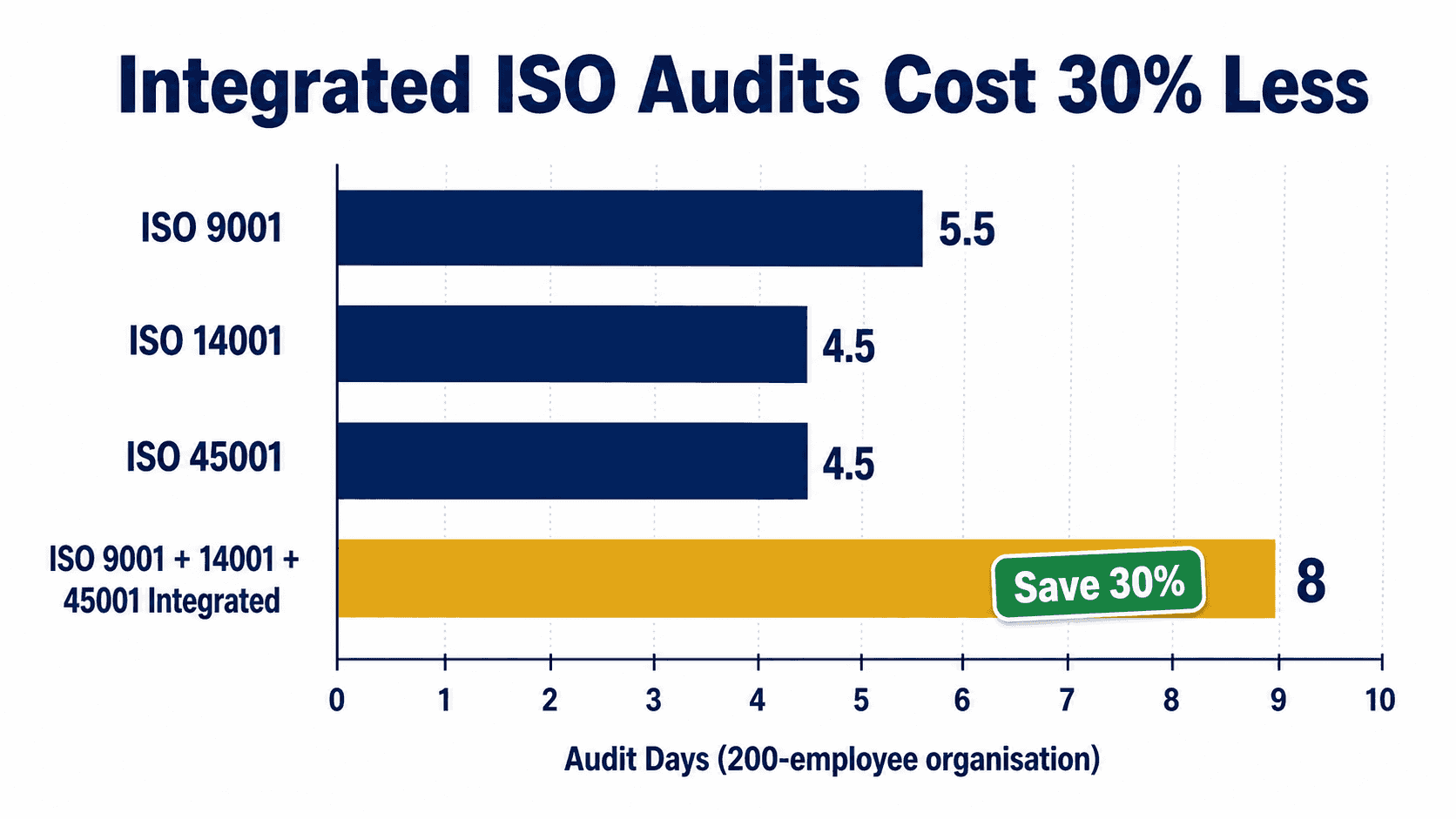
UniCert's integrated audit clients — organisations certified to ISO 9001 + ISO 45001, or ISO 9001 + ISO 14001 + ISO 45001 simultaneously — consistently pay at least 30% less than organisations that pursue each standard separately. The saving exists because audit days overlap: a management system review, a leadership interview, and an internal audit examination serve all three standards at once. Running three separate audits charges that time three times.
| Standard | Relative Audit Complexity | Typical Audit Days (200 employees) | Key Cost Driver |
|---|---|---|---|
| ISO 9001 | Low–Medium | 5–6 days | Process complexity, number of sites |
| ISO 14001 | Low–Medium | 4–5 days | Number of environmental aspects, regulated sectors |
| ISO 45001 | Medium | 4–5 days | Hazard categories, contractor management |
| ISO 27001 | High | 6–8 days | Technical scope, number of information assets |
| ISO 9001 + 14001 + 45001 integrated | Medium | 7–9 days combined | ~30% lower than three separate audits |
ISO Survey 2023 records over 1.08 million ISO 9001 certificates globally, making it the most widely held management system standard in the world — and the benchmark against which every other standard's cost is compared.
For UK businesses exporting to European supply chains or bidding on public sector contracts, the integrated triple standard (9001 + 14001 + 45001) has become the de facto expectation in tender pre-qualification questionnaires. Achieving all three in a single audit cycle is both the financially rational and commercially strategic choice.
Explore integrated ISO certification options or see how audit days are calculated in our integrated management system certification guide.
What drives ISO certification costs up — and what you can control?
The two cost drivers organisations cannot control are employee headcount and the number of sites, because both are mandated inputs to audit day calculations under ISO/IEC 17021-1. Everything else — preparation quality, scope definition, documentation accuracy, and choice of certification body — is within the organisation's control.
What you cannot control:
- Minimum audit days required by accreditation standards (headcount-linked)
- Auditor travel costs for remote or international sites
- Follow-up audit fees if major nonconformities are raised (though you can eliminate the risk)
What you can control — and where most organisations lose money:
Scope creep. Defining an overly broad certification scope — including processes, sites, or activities that add audit days without adding commercial value — is the most common avoidable cost. A manufacturing company certifying its head office administration alongside its production floor may be paying for audit time that no client or tender requirement actually needs.
Documentation gaps between procedures and practice. Certification bodies audit what organisations actually do, not what their procedures say. When auditors find that documented procedures describe a process that the operation does not follow, that is a major nonconformity. The resulting follow-up visit is an unbudgeted cost that is entirely within the organisation's control to prevent by running a credible internal audit before Stage 2.
Choosing a body based on price alone without checking accreditation scope. The UK Government's conformity assessment guidance makes clear that accreditation scope — which standards a body is authorised to certify — should be verified before engagement. A lower quoted fee from a body not authorised for your specific standard creates certificates that procurement teams and export markets may not accept.
Get a quote and check UniCert's accreditation scope
Does the certification body you choose affect the cost — and does it matter globally?
The certification body you choose affects both the upfront cost and whether your certificate is accepted by clients, procurement bodies, and export markets — and the two factors pull in opposite directions in ways that most pricing comparisons ignore. For UK businesses operating internationally or bidding on public contracts, accreditation under the IAF Multilateral Recognition Arrangement (IAF MLA) is the critical requirement, not UKAS membership specifically.
This is a point most UK ISO cost guides miss entirely. UKAS is the UK's national accreditation body and an IAF MLA signatory — but it is one of 106 IAF MLA signatories worldwide. UniCert is accredited by UAF (United Accreditation Foundation), itself an IAF MLA member and APAC-recognised body. The practical result: UniCert certificates carry IAF MLA recognition and are accepted in 170+ countries — the same global standing as a UKAS-accredited certificate, at a more competitive fee structure.
The question UK businesses should ask when comparing certification bodies is not "are they UKAS?" but "are they accredited by an IAF MLA signatory?" — because that is what determines international and public sector acceptance. The IAF member directory is publicly searchable and takes 30 seconds to verify.
What IAF MLA accreditation means in practice:
- Certificates accepted by procurement bodies across EU, US, Middle East, and Asia-Pacific markets
- No re-certification required when selling into new international markets
- Recognition by national accreditation bodies in 106 countries under mutual recognition
UAF accreditation also tends to produce more competitive fee structures than some UKAS-accredited bodies, because UAF operates with lower overhead costs while maintaining equivalent technical rigour under IAF MLA governance. For a small UK business certifying to ISO 9001, the difference between a £1,000 UniCert initial certificate and a £3,500+ first-year package from a larger UKAS body is material — with identical international standing.
What does ISO certification cost over a 3-year cycle, not just year one?
ISO certification operates on a mandatory 3-year cycle: an initial certification audit, followed by annual surveillance audits in years two and three, then a recertification audit to begin the next cycle. Budgeting for year one only — as most cost guides implicitly encourage — understates the true commitment by roughly 60%.
At UniCert, the 3-year total cost for a small organisation (ISO 9001, single site, up to 25 employees) is:
| Year | Activity | Fee |
|---|---|---|
| Year 1 | Stage 1 + Stage 2 (initial certification) | £1,000 |
| Year 2 | Surveillance audit | £700 |
| Year 3 | Surveillance audit | £700 |
| 3-year total | £2,400 |
For a medium organisation, the equivalent 3-year total is approximately £3,500 (£1,500 + £1,000 + £1,000). These are certification body fees only. Organisations that self-manage their system — which most do after the first year — carry no additional third-party costs beyond this.
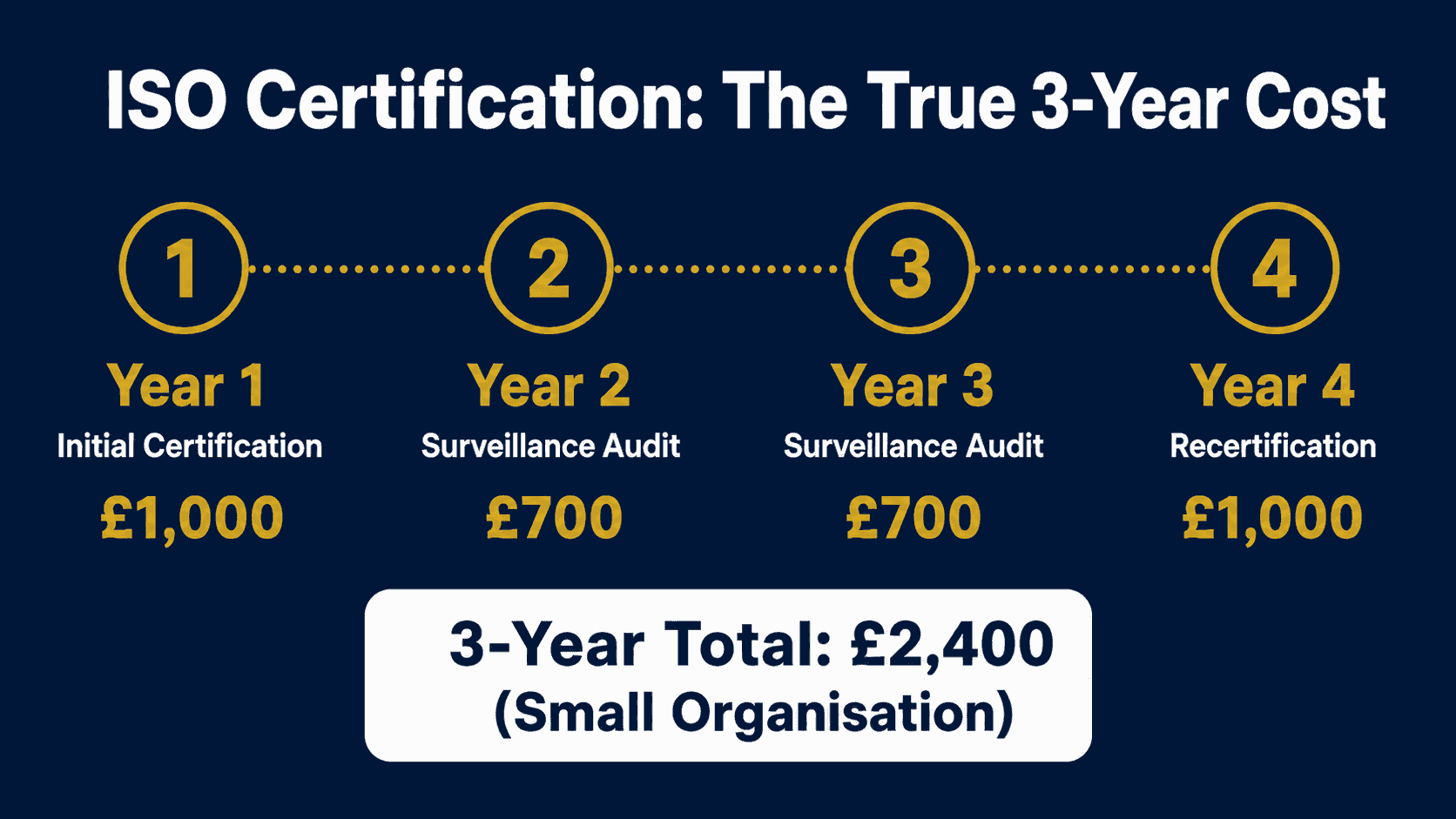
The recertification audit at the end of year three is priced similarly to the initial certification, beginning the next cycle. Organisations that maintain their management system actively between audits — closing internal audit findings, reviewing objectives, and keeping documentation current — consistently pass surveillance and recertification with no additional follow-up costs. Those that treat the system as dormant between visits typically face major findings and the unplanned expense of a follow-up audit.
Frequently Asked Questions
How long does ISO 9001 certification take in the UK?
Most organisations achieve initial certification within 3–6 months of beginning preparation, depending on the maturity of existing processes. The certification audit itself (Stage 1 and Stage 2) typically takes place over 2–5 days depending on organisation size.
Can a small business afford ISO 9001 in the UK?
Yes — initial certification fees start from £1,000 at an IAF-accredited body, with annual surveillance from £700. For a business winning even one additional contract because of the certificate, the return on investment is typically achieved within the first year.
Is a UAF-accredited ISO certificate accepted in the UK and internationally?
UAF (United Accreditation Foundation) is a full member of the IAF Multilateral Recognition Arrangement, meaning UAF-accredited certificates carry the same international standing as certificates from any other IAF MLA signatory, including UKAS. They are accepted in 170+ countries and by UK public sector procurement bodies.
What happens if major nonconformities are found during the ISO audit?
Major nonconformities prevent the certificate from being issued until resolved. The certification body will schedule a follow-up visit to verify closure, which is charged as an additional audit event. This cost is avoidable: a thorough internal audit and gap review before Stage 2 is the most reliable way to prevent it.
Related certifications:

Take the Next Step with UniCert
From ISO 9001 quality management to cyber security and supply chain assurance – UniCert provides the management system certification you need to unlock global markets.