ISO 9001 for Service Businesses: A Practical Guide
If a client or a tender has asked your firm for ISO 9001, the standard was built to fit you. ISO 9001:2015 is generic by design. It applies to any organisation regardless of size or sector, and whether it sells products or services [1]. There is no separate "ISO 9001 for services" standard to find. Consultancies, marketing and design agencies, IT managed service providers, recruiters, facilities management firms and logistics operators all certify against the same ISO 9001:2015 as a factory.
The work for a service business is translation. ISO 9001 refers to "product", "production and service provision", "nonconforming output", "customer property" and "monitoring and measurement". None of these terms requires a physical item on a production line, though they read that way on a first pass. This guide gives a worked interpretation of each term, a translation table you can lift into your scope document, a practical picture of a service quality management system, and a numbered route to certification. It sits under our broader guide to integrated management system certification.

ISO 9001 applies to service teams through the same clauses 4 to 10 that manufacturers use. Source: UniCert
Does ISO 9001 apply to service businesses?
Yes, and it is the same standard. ISO 9001:2015 is the world's most widely used quality management standard, with more than one million certificates issued across over 180 countries [4], and it applies to any organisation regardless of what it produces [1]. Its requirements sit in clauses 4 to 10 and describe a management system, not a manufacturing line. Service firms follow the same ISO 9001 certification route in the UK as any other applicant.
The honest detail is about applicability, not about a different standard. Under Clause 4.3 you define the scope of your quality management system, and you may record a specific requirement as "not applicable" only where it does not affect your ability to deliver conforming services and enhance customer satisfaction [1]. That decision has to be justified in your documented scope. The common justified example for service firms is calibration of monitoring and measuring equipment (Clause 7.1.5): a firm that holds no measuring equipment affecting service conformity does not apply that requirement [7]. Almost everything else in the standard does apply.
The five translation problems
In the ISO 9001 audits I run for service firms, the same five terms cause almost all of the early confusion. Work through these and most of the standard falls into place. To see how the same clauses read in a product setting, our ISO 9001 for manufacturing guide covers the product-based interpretation of the same requirements.
What is your "product" or deliverable?
Define this first, because most other clauses refer back to it. Your "product" under ISO 9001 is the output your client pays for [3]. For a consultancy it is the report, the model or the advice note. For a design or marketing agency it is the campaign, the asset pack or the delivered website. For an IT managed service provider it is the resolved ticket, the maintained service and the delivered change. For a recruiter it is the shortlist and the placed candidate. For a facilities or logistics firm it is the completed service visit or the delivered consignment.
Write this down in plain words. The requirements for that deliverable come from the client brief, the statement of work, the contract and any applicable legal or regulatory duties. That set of requirements is what Clause 8.2 means by "requirements for products and services", and it is what you check against before delivery [3].
Production and service provision (8.5) is your delivery workflow
Clause 8.5 asks you to deliver "under controlled conditions" [2]. For a service business that means a defined, repeatable delivery workflow: how a piece of work moves from briefing, through resourcing and production, to review and client sign-off. Controlled conditions include having the brief available to the people doing the work, suitable tools and templates, competent people, and defined review or approval points before the deliverable leaves the building [2]. Practitioner interpretation guidance reads the same clause the same way for services [9] (secondary).
You do not need a heavy procedure for every service line. You need enough definition that a new joiner would deliver the work the same way an experienced colleague would. A one-page process map plus templates is often enough for a small firm.
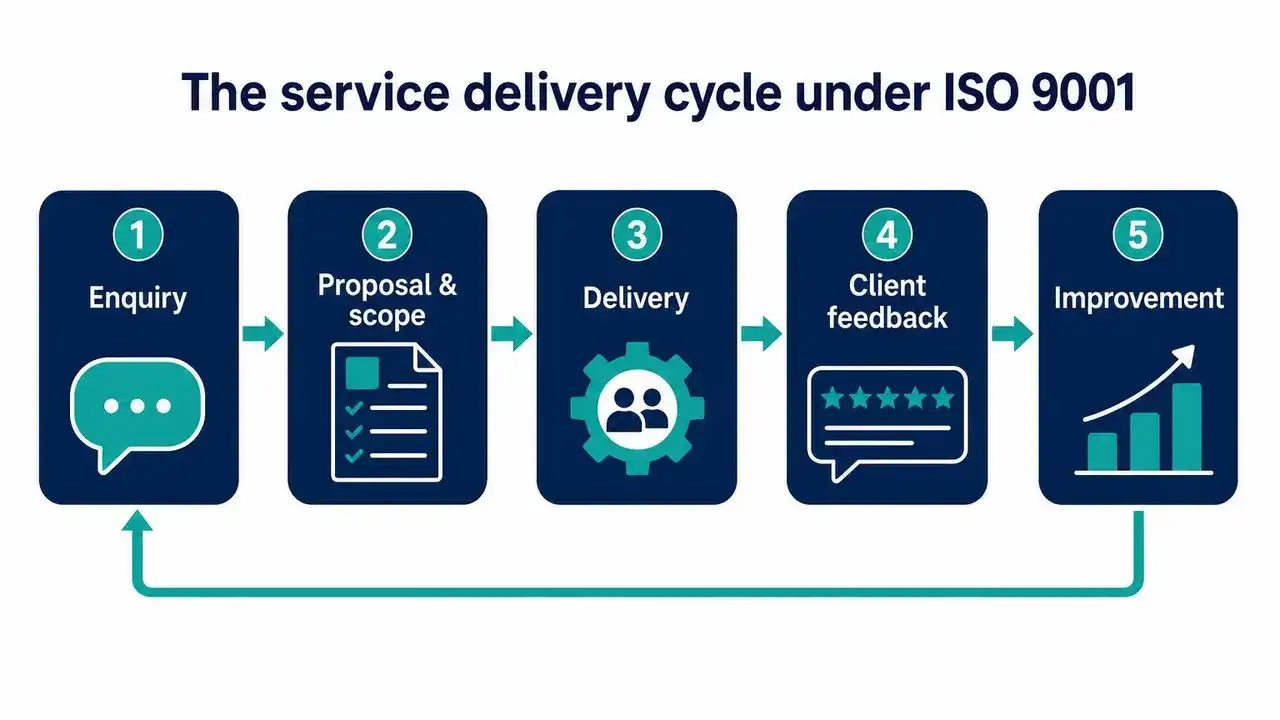
Clause 8.5 controlled conditions expressed as a service delivery workflow. Source: UniCert
Nonconforming output (8.7) is rework, missed SLAs and complaints
Clause 8.7 covers what you do when a deliverable does not meet requirements [2]. In a service firm that is not a defective part. It is the draft sent back for rework, the SLA target you missed, the invoice dispute, the upheld client complaint, or the campaign that went live with an error. Clause 8.7 asks you to identify these, contain them where you can, address the consequence with the client, and keep a record of what happened and who authorised the resolution [2].
The practical step is a simple log. Record the issue, the client impact, the correction, and whether you are treating it as a one-off or opening a corrective action under Clause 10.2. Auditors look for evidence that the log is used and reviewed, not that it is empty.
Customer property (8.5.3) is client data, credentials and brand assets
Clause 8.5.3 protects property the customer provides for you to use or incorporate into the work [2]. For service firms this is rarely physical. It is client data and personal data, system logins and API credentials, source files and documents, brand assets and style guides, and sometimes access to client premises or equipment. The clause requires you to identify it, protect it, and tell the client promptly if any of it is lost, damaged or found unsuitable for use [2].
This requirement overlaps with your information security and data protection obligations, which is one reason service firms often run ISO 9001 alongside ISO 27001. A register of the client-owned information and access you hold, per engagement, usually satisfies the quality auditor.
Monitoring and measurement (9.1) is SLAs, QA reviews, CSAT and error rates
Clause 9.1 asks what you measure to know the work is good and clients are satisfied [3]. Service firms already hold most of this data. Service-level agreement performance, internal quality assurance or peer review results, client satisfaction and Net Promoter scores, on-time delivery, revision and rework rates, complaint volumes and utilisation against plan all count. The standard's emphasis on meeting customer requirements and enhancing customer satisfaction maps directly onto SLAs, scope documents and structured client feedback [3].
Pick a small set of measures that reflect real quality for your service, set targets, and review them at management review. You do not need a large dashboard. You need evidence that you track performance and act when it drifts.
ISO 9001 to service business translation table
Use this table as a starting point for your scope document. The left column is the standard's language, the middle column is the service reading, and the right column is the evidence an auditor would expect to see.
| ISO 9001:2015 term / clause | What it means in a service business | Example evidence an auditor would accept |
|---|---|---|
| Product / output (Clause 8.1) | The deliverable the client pays for: a report, a campaign, a placed candidate, a resolved ticket, a completed site visit | Statement of work, signed client brief, delivery register linking each engagement to its agreed outputs [3] |
| Production and service provision (Clause 8.5) | Your end-to-end delivery workflow, from briefing through resourcing and production to review and client sign-off | Process map, work instructions, project records showing the workflow was followed, dated sign-off records [2] |
| Nonconforming output (Clause 8.7) | Work that fails requirements: rework, a missed SLA, an invoice dispute, an upheld complaint, a campaign published with an error | Nonconformity log recording the issue, client impact, correction and the person who authorised release or resolution [2] |
| Customer property (Clause 8.5.3) | Client-owned items you hold: personal and business data, system logins and API keys, source files, brand assets, site access | Per-engagement register of client data and access, handling and return rules, records of any loss reported to the client [2] |
| Monitoring, measurement, analysis and evaluation (Clause 9.1) | The measures that show work is good and clients are satisfied: SLA performance, QA review results, CSAT or NPS, on-time delivery, rework rates | Trend data against targets, QA review records, client feedback summaries, management review minutes acting on the data [3] |
What a service QMS looks like in practice
A service quality management system is smaller and lighter than most first-timers expect. The core pieces are a defined scope and context, a process map of how you win and deliver work, clear roles and responsibilities, and a modest set of documented information: the policies and procedures the standard requires, plus the templates your team actually uses. Cost-conscious founders can find realistic budgets in our guide to affordable ISO certification for UK startups and our overview of ISO certification for small businesses in the UK.
Document control that fits a small firm usually means one shared, access-controlled drive or intranet, version labels on live templates, and a named owner for each document. Competence (Clause 7.2) is covered by role descriptions, a skills matrix and records of training or professional membership [8]. Supplier control (Clause 8.4) applies to the subcontractors, freelancers and associates who deliver work on your behalf: keep an approved list, set expectations in writing, and review their output through the same QA step you apply to internal work [8].
Other sectors layer extra rules on top of this same core. Where a client operates under sector-specific expectations, such as construction, the quality system has to meet those too. Our guide to ISO 9001 and ISO 45001 with CDM 2015 for construction shows how that looks when health and safety duties sit alongside quality.
A numbered route to certification
The certification route is the same for every sector, and it follows ISO/IEC 17021-1 [5]. Under IAF MD 5, audit duration is sized from your effective headcount and complexity, so a small service firm faces a short audit [6]. Our step-by-step walkthrough of how to get ISO 9001 certified in the UK covers each stage in more detail.
- Gap analysis. Compare current practice against clauses 4 to 10. Note what exists, what needs writing down, and what needs to start happening.
- Build and implement the QMS. Define scope and processes, write the documented information, and run the system long enough to generate records.
- Internal audit and management review. Audit your own system against the standard, then hold a management review covering performance, nonconformities, feedback and improvement.
- Stage 1 certification audit. The certification body checks your documentation and readiness, and flags anything that would block Stage 2 [5].
- Stage 2 certification audit. The auditor tests whether the system works in practice, through interviews, records and sampling of real engagements [5].
- Certification and surveillance. Once any findings are closed you receive the certificate. Surveillance audits follow each year, with recertification every three years [5].
For a ten-person agency that already delivers against briefs and contracts, documentation is rarely the limiting factor. The constraint is time on the clock: you need three to four months of records from a running system, including completed QA reviews, a used nonconformity log, at least one internal audit and one management review. Book Stage 2 once those records exist [5][6].
Sector notes
Marketing, design and creative agencies. The deliverable is creative output against a brief. Auditors focus on brief sign-off, version control on creative files, the internal review before client release, and how you handle amends and scope creep.
IT managed service providers. The service is ongoing. Expect attention on SLA definitions and reporting, change and incident handling, the link to client credentials and data as customer property, and how subcontracted support is controlled. Our sector page on ISO certification for technology companies covers the overlap with ISO 27001.
Professional services and consultancies. The risk is judgement and accuracy. Auditors look at technical review before advice is issued, competence records for named experts, and how you capture client feedback on engagements.
Facilities management and logistics. The work happens across many sites or in transit. Expect focus on planning and scheduling, service records from the field, subcontractor control, and how missed visits or delivery exceptions are logged and resolved. See our ISO certification for logistics and transport page for distribution-specific detail.
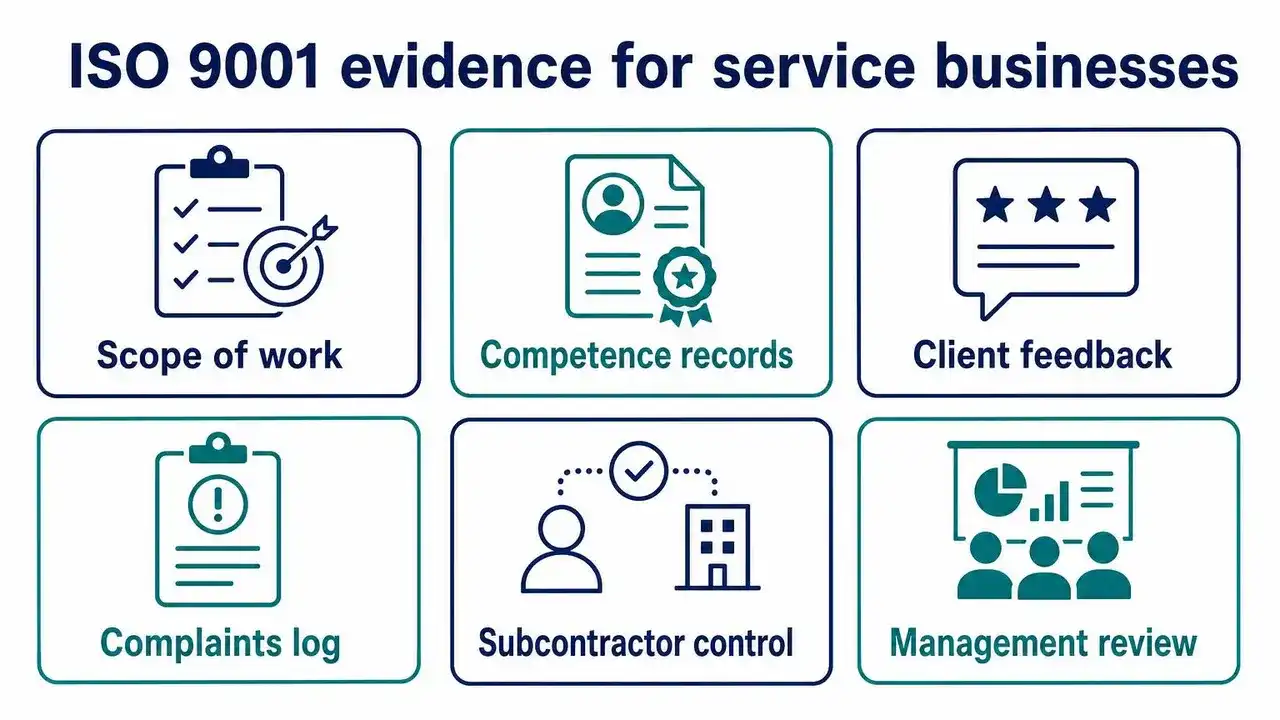
Practical summary of the key steps covered in this guide. Source: UniCert
Frequently asked questions
Is there a version of ISO 9001 just for service companies?
No. Service firms certify against ISO 9001:2015, the same standard manufacturers use. It is written in generic "products and services" language so that one standard fits any sector [1].
Can we exclude parts of ISO 9001 that do not fit a service model?
Only with justification. Clause 4.3 lets you record a requirement as "not applicable" where it does not affect your ability to deliver conforming services or satisfy customers, and you must state why in your scope. Calibration under Clause 7.1.5 is the usual example for firms with no measuring equipment [1][7].
How long does certification take for a small service firm?
Timing depends on how much already runs in a structured way. A firm with signed briefs, defined delivery steps and client feedback mainly needs to formalise them, then operate the system long enough to produce internal audit and management review records. That is commonly one to two quarters from gap analysis to Stage 2 [5][6].
Do we need to document every process?
No. You need the documented information the standard requires, plus enough definition that work is delivered consistently. For many small firms that is a process map, a set of templates and a handful of procedures [1].
What do auditors most often raise in service-firm audits?
In my experience the frequent gap is internal audit and management review being treated as a one-off exercise rather than a cycle operated through the year. Running both on a schedule, with records, resolves it.
Start with your deliverable, not the standard
The fastest way into ISO 9001 as a service firm is to name your deliverable first, then work outward. Write down what the client pays for, then how you produce it, then how you catch and log the times it falls short, then what client-owned information you hold, then the handful of measures that show quality. Those five decisions cover the clauses that trip people up, and the translation table above turns each one into audit-ready evidence. When you are ready to add environmental or health and safety management, our guide to integrated management system certification shows how the same structure carries across standards.
Editorial note: UniCert is UAF-accredited for ISO 9001, ISO 14001 and ISO 45001, and is an IAF MLA signatory through that accreditation. Accreditation details: /accreditation.
References
- ISO. ISO 9001:2015, Quality management systems: requirements. Geneva: ISO, 2015. Generic standard applicable to any organisation regardless of size or sector; requirements in clauses 4 to 10; Clause 4.3 on determining scope and recording requirements as not applicable with justification. https://www.iso.org/standard/62085.html
- ISO. ISO 9001:2015, Clause 8.5 (production and service provision), Clause 8.5.3 (property belonging to customers or external providers) and Clause 8.7 (control of nonconforming outputs). Geneva: ISO, 2015. https://www.iso.org/standard/62085.html
- ISO. ISO 9001:2015, Clause 8.1 and Clause 8.2 (requirements for products and services) and Clause 9.1 (monitoring, measurement, analysis and evaluation). Geneva: ISO, 2015. https://www.iso.org/standard/62085.html
- ISO. The ISO Survey of Management System Standard Certifications. https://www.iso.org/the-iso-survey.html. More than one million ISO 9001 certificates recorded across more than 180 countries.
- ISO/IEC. ISO/IEC 17021-1:2015, Conformity assessment: requirements for bodies providing audit and certification of management systems. Two-stage initial certification audit, annual surveillance and three-yearly recertification. https://www.iso.org/standard/61651.html
- IAF. IAF MD 5, Determination of audit time of quality, environmental and occupational health and safety management systems. Audit duration derived from the effective number of personnel and organisational complexity. https://www.iaf.nu
- ISO. ISO 9001:2015, Clause 7.1.5 (monitoring and measuring resources). Geneva: ISO, 2015. Basis for the common calibration exclusion where no measuring equipment affects service conformity.
- ISO. ISO 9001:2015, Clause 7.2 (competence) and Clause 8.4 (control of externally provided processes, products and services). Geneva: ISO, 2015.
- 9001simplified (secondary). Practitioner interpretation guidance applying "production and service provision" to service delivery workflows. Used only to corroborate the reading in reference 2.