
What Is a PQQ? Pre-Qualification Under the Procurement Act
What a PQQ (pre-qualification questionnaire) means, how it became the SQ and then the PSQ, and how supplier selection works under the Procurement Act 2023.
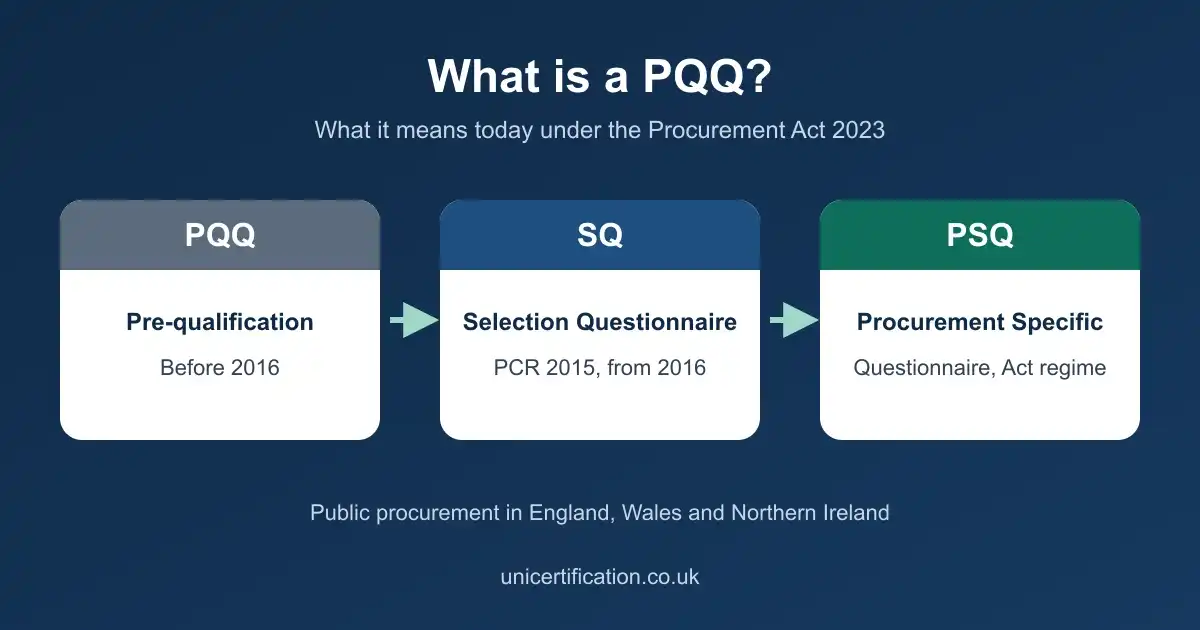
A PQQ, or pre-qualification questionnaire, is a set of questions a buyer uses to check whether a supplier is suitable before inviting it to tender. In public procurement the official name has changed twice. The standard PQQ became the Selection Questionnaire (SQ) in 2016, and since the Procurement Act 2023 came into force on 24 February 2025, suppliers share core information through the Central Digital Platform and answer procurement-specific questions. Many buyers and bidders still say "PQQ" for all of these. This guide explains what a PQQ means today, how supplier selection works under the Act, and how certificates such as ISO 9001 certification can support your answers.
What does PQQ mean?
PQQ stands for pre-qualification questionnaire. It asks a supplier for basic company details, financial information, declarations about exclusion grounds and evidence of technical ability. The buyer uses the answers to decide which suppliers meet its minimum requirements and, in some procedures, which suppliers to shortlist.
A PQQ is not the tender. The tender explains how you would deliver the contract and at what price. The PQQ asks whether you are a suitable supplier in the first place. Public bodies, utilities, main contractors and large private companies all use some form of pre-qualification. The statutory process applies to public contracting authorities and, for utilities contracts, to private utilities.
From PQQ to SQ to PSQ: how the name changed
The term "PQQ" survives because it was the standard name for years. The official documents have moved on.
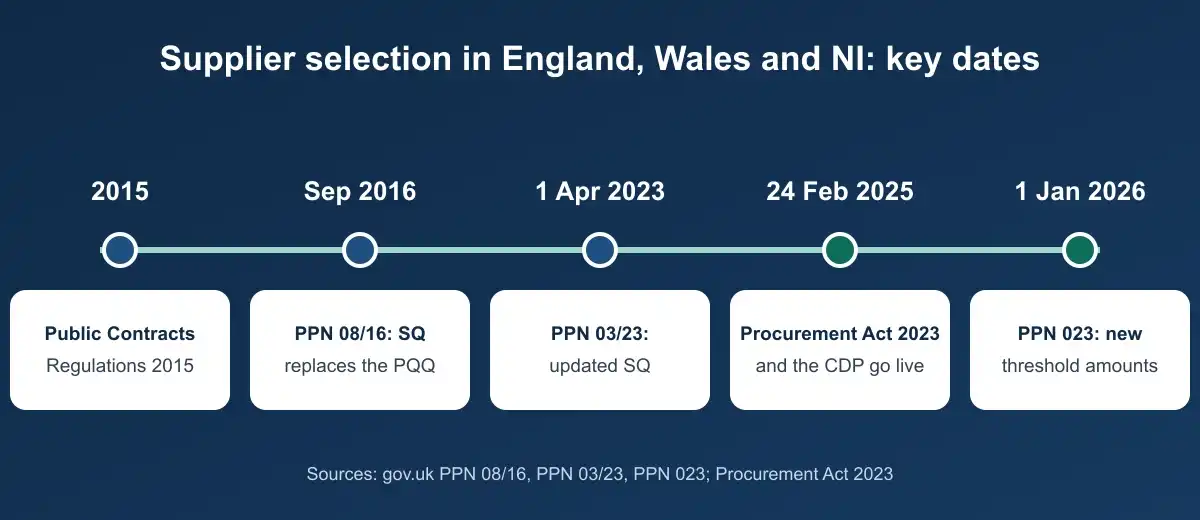
Sources: GOV.UK PPN 08/16, PPN 03/23 and PPN 023; Procurement Act 2023.
- Public Contracts Regulations 2015. These regulations governed most public procurement in England, Wales and Northern Ireland until February 2025.
- September 2016: the Selection Questionnaire. Procurement Policy Note 08/16 introduced a standard Selection Questionnaire to replace the standard PQQ for above-threshold procurements (GOV.UK).
- 1 April 2023: an updated SQ. PPN 03/23 replaced PPN 08/16 with a revised SQ and statutory guidance (GOV.UK).
- 24 February 2025: the Procurement Act 2023. Procurements started on or after this date follow the Act and the Procurement Regulations 2024. Suppliers now register on the Central Digital Platform, which is accessed through Find a Tender.
- 1 January 2026: new thresholds. PPN 023 set the threshold amounts that apply to procurements starting on or after this date (GOV.UK).
Procurements started before 24 February 2025 continue under the old rules, so you may still see an SQ on a long-running framework.
How supplier selection works under the Procurement Act 2023
The Act applies to contracting authorities in England, Wales and Northern Ireland, and to authorities with reserved functions, including when they procure in Scotland. Devolved Scottish authorities follow Scotland's own procurement legislation instead (GOV.UK). Private utilities count as contracting authorities only for utilities contracts.
Under the Act, much of what a PQQ used to ask is collected once, on the Central Digital Platform (CDP), and shared with each buyer. The Procurement Regulations 2024 define four categories of core supplier information: basic information, economic and financial standing information, connected person information and exclusion grounds information (regulation 6) (legislation.gov.uk).
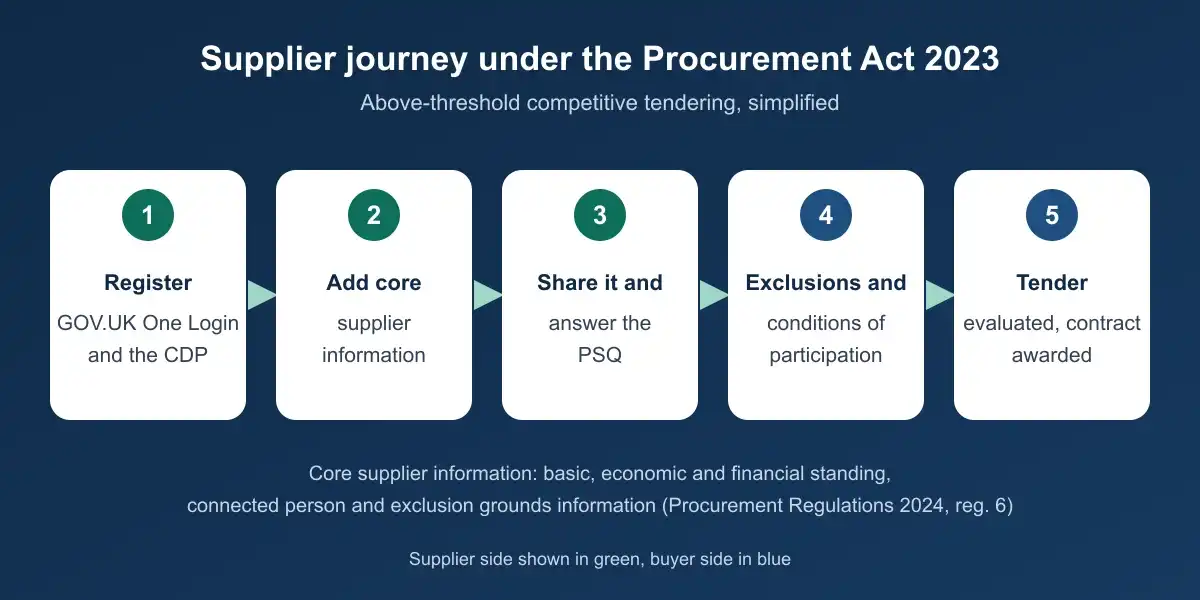
Sources: Procurement Act 2023, Procurement Regulations 2024 (regulation 6) and the Procurement Pathway PSQ template.
Buyers then ask the questions specific to their contract, often through a Procurement Specific Questionnaire (PSQ). The government publishes a standard PSQ template that collects core supplier information from the CDP, additional exclusions and debarment information, and information on conditions of participation; it "will fulfil a similar role to the Standard Selection Questionnaire" (Procurement Pathway). The Act itself does not prescribe the form, and buyers can adapt the template to the contract. In practice, the PSQ is the closest thing to a PQQ under the new regime.
Open and competitive flexible procedures
For public contracts above the thresholds, whether there is a separate pre-qualification stage depends on the procedure. Section 20 of the Act allows two competitive tendering procedures (legislation.gov.uk):
- Open procedure: "a single-stage tendering procedure without a restriction on who can submit tenders". There is no shortlisting stage, so suitability is checked within the single round.
- Competitive flexible procedure: any other competitive procedure the buyer "considers appropriate". It may limit the number of participating suppliers and may exclude suppliers that do not meet the conditions of participation, which is where a PQQ-style shortlist survives.
Conditions of participation
The questions a buyer can ask are limited by section 22 of the Act (legislation.gov.uk). A buyer may set conditions of participation only where they are a proportionate means of ensuring suppliers have the legal and financial capacity, or the technical ability, to perform the contract. In particular:
- conditions may relate to suppliers' qualifications, experience or technical ability;
- a buyer cannot "require particular qualifications without allowing for their equivalents";
- audited accounts can be required only from suppliers that must have their accounts audited under the Companies Act 2006, or an overseas equivalent;
- insurance for the contract cannot be required to be in place before award;
- a condition may require evidence that is "verifiable by a person other than the supplier".
When judging proportionality, buyers must have regard to "the nature, complexity and cost of the public contract". A small cleaning contract should not carry the same questions as a hospital construction project.
Below-threshold contracts
For a regulated below-threshold contract, a buyer "may not restrict the submission of tenders by reference to an assessment of a supplier's suitability" (section 85). In other words, there is no shortlisting PQQ stage for most smaller public contracts. There are three exceptions. The first is works contracts worth at least £135,018 (central government) or £207,720 (other authorities), the same figures as the supplies and services thresholds. The others are awards under a framework and certain Welsh arrangements.
Before inviting tenders for any regulated below-threshold contract, buyers must also have regard to the barriers small and medium-sized enterprises face. This duty does not apply to awards under a framework (section 86).
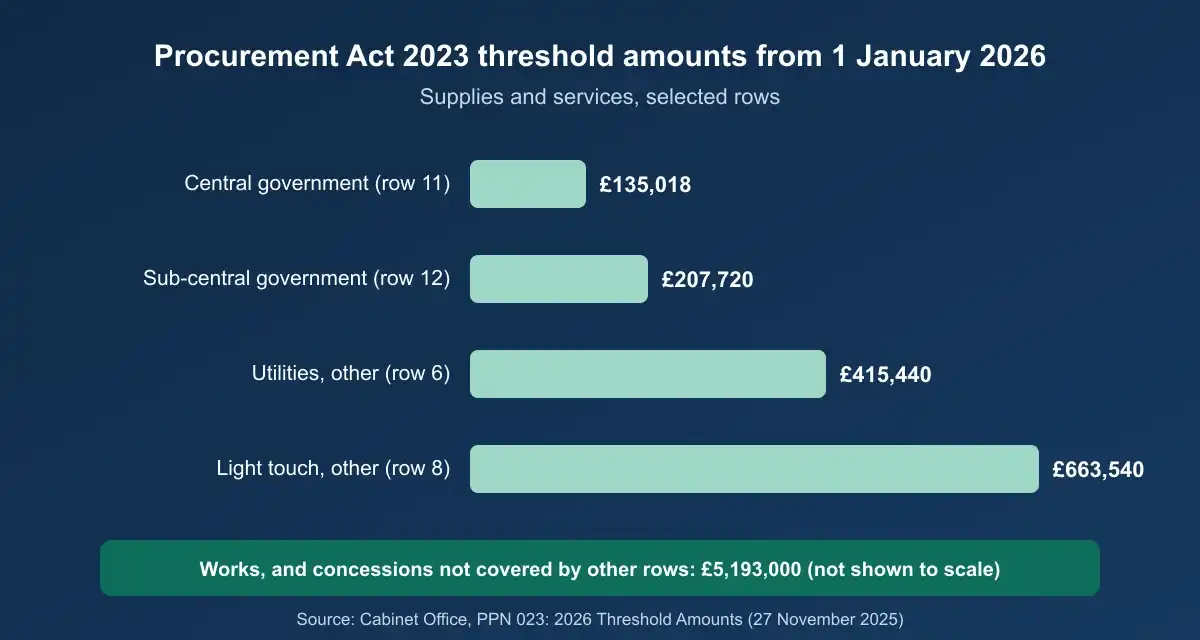
Source: Cabinet Office, PPN 023: 2026 Threshold Amounts.
The thresholds decide which rules apply. From 1 January 2026, the main amounts are £135,018 for central government supplies and services, £207,720 for sub-central authorities and £5,193,000 for works and most concessions (PPN 023). Separate amounts apply to utilities supplies and services contracts (£415,440) and to other light-touch contracts (£663,540).
What a PQQ or PSQ usually asks
Every buyer sets its own questions within the rules, so the list below is a typical structure rather than a fixed form.
| Section | What the buyer wants to know | Typical evidence |
|---|---|---|
| Supplier details | Who you are and who controls the company | Company number, registered address, connected persons (shared through the CDP) |
| Exclusion grounds | Whether any mandatory or discretionary exclusion grounds apply | Declarations shared through the CDP |
| Economic and financial standing | Whether you can carry the contract financially | Core information shared through the CDP; accounts and turnover within section 22 limits |
| Technical ability | Whether you have done similar work well | Contract examples, references, staff qualifications |
| Management systems | How you control quality, environment, health and safety and information | Policies, procedures, certificates such as ISO 9001, ISO 14001, ISO 45001 or ISO/IEC 27001 |
| Contract-specific policies | Whether you meet policy requirements for this contract | Cyber Essentials, a Carbon Reduction Plan, social value commitments |
Two policy notes for central government and related bodies add requirements that often appear in these sections:
- Cyber Essentials (PPN 014). For central government departments, their executive agencies, non-departmental public bodies and NHS bodies, Cyber Essentials or Cyber Essentials Plus applies to contracts involving certain personal data, government information or ICT systems at OFFICIAL level, and must be renewed every year. Suppliers can instead show equivalent controls, and the note warns against a blanket approach (GOV.UK).
- Carbon Reduction Plans (PPN 006). Central government buyers ask for a Carbon Reduction Plan as a condition of participation where a contract is worth more than £5 million a year, where relevant and proportionate (Procurement Pathway). An environmental management system under ISO 14001 certification can support the environmental management part of that plan.
Where ISO certification fits
An ISO certificate does not answer a PQQ for you. Where it is proportionate, a buyer may ask for evidence of technical ability, and a certificate from an independent body is one way to show that a management system is in place. Where a buyer sets a particular qualification as a condition, section 22 requires it to allow for equivalents. Each standard supports a different set of questions:
- Quality: ISO 9001 supports questions on process control, complaints and continual improvement.
- Environment: ISO 14001 supports questions on environmental impacts, legal compliance and carbon.
- Health and safety: ISO 45001 certification supports questions on risk assessment, incidents and worker participation.
- Information security: ISO/IEC 27001 certification supports questions on data protection and security controls.
If you hold several certificates, an integrated management system lets you answer quality, environment and safety questions from one set of records.
Read the wording of each question carefully. Some buyers name a specific accreditation route, for example certificates issued under UKAS accreditation. UKAS is the UK's national accreditation body. UniCert is accredited by the United Accreditation Foundation (UAF), not by UKAS, so check whether a buyer specifies UKAS before you rely on any certificate, including ours. The guide on whether UAF accreditation is recognised in the UK explains where UAF-accredited certificates are accepted and where UKAS is specifically required, and the accreditation page gives the details. If a requirement is unclear, ask the buyer through the clarification process before you bid.
Construction and private sector pre-qualification
Construction has its own pre-qualification standard. The Build UK Common Assessment Standard is an industry question set for pre-qualifying construction suppliers. Version 5 was published on 1 July 2025 and made its Building Safety section mandatory (Designing Buildings). If you work in the sector, see the UniCert page on ISO certification for construction and our guide to ISO 9001 and ISO 45001 under CDM 2015.
Most private companies are not bound by the Procurement Act, so their PQQs can ask for anything they consider relevant. One exception is a private utility awarding a utilities contract, which the Act covers. Expect questions similar to the public sector ones, often with the buyer's own health and safety, insurance and quality requirements added.
How to prepare for a PQQ or PSQ

Illustrative image, AI-generated.
- Register early. Create a GOV.UK One Login and register on the Central Digital Platform before you need it, then keep your core supplier information up to date.
- Read the conditions of participation. Check what the buyer actually requires for this contract and how each condition will be assessed.
- Answer the question asked. Use the buyer's terms and give specific examples instead of general claims.
- Keep certificates current and verifiable. A buyer may check a certificate with the issuing body, so make sure the scope, sites and expiry date match what you state. The guide to what happens after ISO certification explains surveillance audits and renewal.
- Plan ahead for certification. Certification takes time. The guides on how to get ISO 9001 certified in the UK and ISO certification costs in the UK set out the steps and budget.
Illustrative example: answering a management systems question
Illustrative scenario. The example below was written for this guide. It is not a real tender or a UniCert client.
A buyer's PSQ asks: "Describe how you manage the quality of the services you deliver. Provide evidence." Two answers to the same question:
| Element | Weak answer | Stronger answer |
|---|---|---|
| Claim | "We are committed to the highest quality standards." | "Our services are delivered under a documented quality management system." |
| Evidence | None | ISO 9001 certificate number, issuing body, scope and expiry date, so the buyer can verify it |
| Process | Not described | How complaints are logged, investigated and closed, and how often internal audits run |
| Results | Not given | A named measure the business already tracks, such as on-time completion, reported for the last year |
| Fit to the contract | Generic text reused from another bid | Explains how the same controls apply to the services in this contract |
The stronger answer responds to the actual question, gives evidence a third party can check and links it to the contract. A certificate helps, but only alongside a clear description of how the system works in practice. A supplier without certification can still give equivalent evidence of a documented system, such as procedures, internal audit records and complaint data.
Build an evidence pack

Illustrative image, AI-generated.
Most PQQs and PSQs ask for the same core documents. Keeping them in one place, signed and dated, saves time on every bid. A typical pack holds your company details, financial information, insurance schedules, certificates with their scopes, key policies, contract examples and named referees.
Making the PQQ work for you
A PQQ, whether it is called a PQQ, an SQ or a PSQ, is the buyer's first check that you can deliver. Under the Procurement Act 2023 much of it now sits on the Central Digital Platform, and the remaining questions must be proportionate to the contract. Keep your core information current, read each condition of participation closely and back your answers with evidence a third party can verify.
To see how your management system compares with ISO 9001, an online ISO gap analysis offers a structured self-assessment; it is not consultancy. If certification would strengthen your bids, you can request a quote.
About this guide
- Written by: Ersin Çetin, UniCert Certification. Ersin writes UniCert's guides to ISO management system standards and certification.
- Editorial process: This article was prepared with AI assistance and draws on the legislation and public guidance listed below. The two photo-style images are AI-generated illustrations, not pictures of real people or events. The worked example is an illustrative scenario, not a real tender. This guide is general information, not legal advice.
- Interests: UniCert is a certification body accredited by UAF, and it offers ISO 9001, ISO 14001, ISO 45001 and ISO/IEC 27001 certification.
- Questions or corrections: contact UniCert.
- Legislation references are to the Procurement Act 2023 and the Procurement Regulations 2024 as published on legislation.gov.uk, retrieved 15 October 2026.
Sources
- Procurement Act 2023, section 20 (competitive tendering procedures), section 22 (conditions of participation), section 85 (regulated below-threshold contracts) and section 86 (small and medium-sized enterprises). legislation.gov.uk.
- The Procurement Regulations 2024 (SI 2024/692), Part 2, regulation 6 (core supplier information). legislation.gov.uk.
- Cabinet Office. PPN 023: 2026 Threshold Amounts. 27 November 2025.
- Cabinet Office. PPN 014: Cyber Essentials Scheme. 17 February 2025.
- Government Commercial Function. Procurement Specific Questionnaire, standard template (PA 2023). Procurement Pathway.
- Cabinet Office. PPN 006: Taking account of Carbon Reduction Plans in the procurement of major government contracts. Procurement Pathway.
- Crown Commercial Service. PPN 08/16: Standard Selection Questionnaire (SQ) template. September 2016.
- Cabinet Office. PPN 03/23: Standard Selection Questionnaire (SQ). 2023.
- Cabinet Office. Procurement Act 2023 e-learning, module 1: scope, definitions and general principles. GOV.UK.
- Designing Buildings. Common Assessment Standard updated with mandatory building safety questions. July 2025.
Related certifications:

Take the Next Step with UniCert
From ISO 9001 quality management to cyber security and supply chain assurance – UniCert provides the management system certification you need to unlock global markets.